
Despite the rise of social commerce and conversational AI, email remains the undisputed king of ROI for marketers. In fact, top-performing brands are generating an average ROI of up to $45 for every $1 spent on email marketing.
But the game of email marketing has dramatically changed. It’s harder than ever to get your messages delivered, opened, and engaged with – while getting subscribers to actually convert is an even bigger challenge.
So, how do you cut through the noise and improve your email conversion rates in 2026? You don’t send more emails – you send better ones, more strategically. In this blog, we’ll walk you through 5 ways to optimize your email marketing conversion rate and ensure your email marketing efforts don’t go wasted.
TL;DR
- An email marketing conversion rate is the percentage of recipients who complete a desired action (like making a purchase or signing up) after opening your email.
- To calculate your email conversion rate, divide the number of recipients who completed the desired action by the total delivered emails and multiply by 100.
- A good email conversion rate usually falls between 2–5%, but it can vary based on your industry, conversion goal, and the type of email you send.
- Improving your email conversion rates in 2026 requires strong subject lines, first-person CTAs, mobile-optimized design, AI personalization, and consistent A/B testing.
- Maropost Marketing Cloud boosts email conversion rates by offering optimized send times, high deliverability, dynamic content, AI recommendations, smart segmentation, and built-in A/B testing tools.
What is the email marketing conversion rate?
An email marketing conversion rate measures the percentage of your email recipients who take a desired action after opening your email. This action is your specific conversion goal, such as:
- Making a purchase
- Claiming a promotion
- Entering a giveaway
- Starting a free trial
- Downloading a resource
- Filling out a form
- Signing up for a webinar
- Clicking through to a landing page
Naturally, the higher your email conversion rate it, the better. And for most marketers, email conversion rate is one of the top email marketing metrics to track to evaluate the overall success of their email marketing campaigns.
How to calculate the email conversion rate?
To calculate your email conversion rate, simply divide the number of your email recipients who completed a desired action (conversion) by the total number of delivered emails, and then multiply this number by 100 to get a percentage. Here’s what the formula looks like:
(Number of conversions /number of delivered emails) x 100 = email conversion rate
Let’s say you sent 10,000 emails, 9,800 of them were delivered, and 300 of your email recipients went on to purchase your product after clicking through the email. Your email conversion rate would be:
(300 conversions /9,800 delivered emails) x 100 = 3,06% email conversion rate
What is a good conversion rate for email marketing?
Based on industry statistics, a good email marketing conversion rate is typically 2–5% for most brands. But that varies depending on a number of factors:
- Your industry: Some sectors, like education and B2B, naturally see higher conversion rates than ecommerce and retail.
- Your conversion goal: A soft conversion (like clicking to read a blog post) will have a much higher rate than a hard conversion (like making a high-value purchase).
- Email type: Certain email types, such as abandoned cart reminders, tend to have much higher conversion rates (4%-5%) than general promotional newsletters (1%).
5 Ways to improve your email marketing conversion rate in 2026
1. Use subject lines that actually work right now
If you’re looking to improve your email conversion rates, your subject lines are where to start. The subject line is the first impression of your email in a crowded inbox – and it’s the make-or-break factor that determines whether a recipient will actually open it or not.
Jay Schwedelson, one of the top marketing experts in the U.S. and founder of SubjectLine.com, shared insights on what’s working in email marketing right now at the recent INBOUND 2025 event. So, here are some examples of what works well in terms of subject lines, according to Schwedelson:
- Reverse psychology: Subject lines that downplay urgency or importance (e.g., “This might not apply to you,” “Nothing important here,” or “Keep scrolling” boosted rates by over 20%.
- The magic of "way to": Using "way to" in subject lines (e.g., "Best way to," "Proven way to," or "Fastest way to,”) increased opens by 17-19%.
- Personalization without data: Subject lines like “Exactly the insights you’ve been hunting,” or “This season was made for you” performed 15% better on average.
Recommended reading: 11 Tips to increase your email marketing open rate
2. Write your email CTAs in first person
Poorly crafted subject lines aren’t the only conversion killers. CTA buttons within your emails matter more than most marketers realize. And based on Jay Schwedelson’s insights, using first-person language in your email CTAs can increase click-through rates by 20%. Here’s what it might look like for ecommerce and retail brands:
Purchase / add to cart:
- “Add to my cart”
- “Get mine now”
- “Yes, I want this”
Sale / discount / promo:
- “Show me the deal”
- “Reveal my discount”
- “Apply my coupon”
Loyalty / rewards:
- “Join my rewards”
- “Redeem my points”
- “Activate my perks”
3. Optimize your emails for mobile (that’s where half of them are opened)
Based on stats from Genesys, in 2025, mobile devices accounted for 55%+ of all email opens globally. That’s why making your emails mobile-friendly is no longer optional if you want to increase your conversion rates. Here are some best practices for optimizing your emails for mobile:
- Use short subject lines (25–50 characters) so they don’t get cut off on mobile screens.
- Use large, readable fonts (16px+ for body text and 22–28px for headlines).
- Stick to a single-column layout so the email displays cleanly on small screens.
- Compress images to reduce load time and keep total email size under 1MB.
- Make sure links and CTA buttons are thumb friendly.
- Use mobile-responsive templates so your email automatically adjusts to different screen sizes.
- Keep copy short and scannable with brief paragraphs, bullets, and a clear hierarchy.
- Test emails across multiple devices and modes.
4. Double down on AI-driven personalization
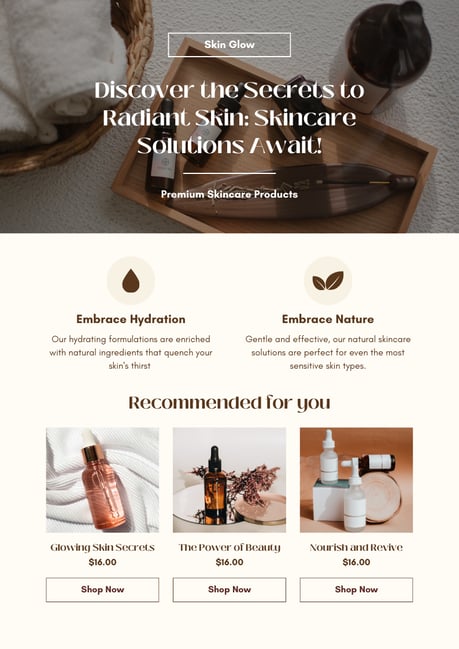
Personalization goes a long way in improving your email conversion rates. But when it comes to email marketing, personalization no longer means just using your subscribers’ names. Users want highly tailored content and offers based on their preferences and unique shopping behavior. Fortunately, modern email marketing platforms provide marketers with a wealth of AI-powered tools to deliver better personalization. These are, for example:
- Dynamic content blocks
- AI product recommendations
- Send-time optimization
- Segmentation based on engagement levels
By analyzing customer behavior and past interactions, AI empowers you to send hyper-personalized emails that feel tailor-made for each subscriber. The outcome? Better engagement and higher conversion rates.
5. Run A/B testing campaigns to see what converts better
Improving your email conversion rate doesn’t have to be a guessing game. That’s where A/B testing comes into play, helping you make more data-driven decisions about your email marketing practices.
Running split test campaigns (A/B testing campaigns) is an excellent opportunity to find out what’s working best. It involves comparing two versions of your email to determine which one leads to more conversions. Better yet, you can test multiple email elements, including the copy, email format, CTAs, and sending times. The rule of thumb here is to test one element at a time so you know exactly what’s driving better results.
How Maropost Marketing Cloud empowers you to achieve a high email conversion rate
With the right strategies and best practices in mind, improving your email conversion rate becomes far more achievable – and Maropost Marketing Cloud gives you all the tools you need to make it happen. Those include:
- Send-time optimization: This enables you to send emails at the moments each contact is most likely to open and engage with your messages based on their past engagement behavior.
- Conversion-time optimization: To go even further, this send option determines the most optimal time to send promotional emails for each contact based on their previous purchase history and when they are most likely to buy.
- 98% deliverability rate: With adaptive delivery, real-time reporting, and dedicated deliverability support and remediation, Maropost ensures a 98% deliverability rate, ensuring your messages land in inboxes, not in spam folders.
- Dynamic content: With dynamic content blocks, one email template can show different images, copy, pricing, and CTAs to different segments automatically, helping you improve relevance and conversions.
- AI product recommendations: By automatically inserting relevant product suggestions into your emails based on customer preferences and past purchases, you can encourage cross-sells, boost conversions, and increase AOV.
- Engagement scoring and segmentation: By scoring customers based on engagement metrics, you can tailor email campaigns to each segment, ultimately increasing clicks, conversions, and revenue.
- A/B testing campaigns: With A/B testing tools, you can easily understand which subject lines, layouts, or CTAs work better and adjust your email campaigns to ensure maximum conversions.
Book a demo now to see Maropost Marketing Cloud in action and learn how exactly it can help you craft and send emails that convert.