
2026 is all about hyper-personalization. Your customers want to see relevant messages, offers, product recommendations, and ads tailored to their specific needs and preferences instead of one-size-fits-all campaigns. According to the BCG Global Consumer Radar Survey, the majority of global consumers expect brands to deliver personalized experiences.
And effective marketing personalization starts with strong customer segmentation. Grouping your customers based on shared characteristics enables you to better personalize your marketing campaigns and address each segment’s specific needs. The outcome? Better customer experience and engagement, increased conversions, improved customer retention, and maximized ROI from your marketing campaigns.
So, what’s the best way for ecommerce businesses to segment their customers in 2026? Let’s explore the most effective ecommerce customer segmentation strategies in more detail and how Maropost Marketing Cloud can help you put them into action.
TL;DR
- Ecommerce customer segmentation is the process of grouping customers by shared characteristics or behaviors to deliver more relevant and personalized campaigns.
- Customer segmentation matters in ecommerce because it drives personalization, boosts conversions and retention, and reduces wasted marketing spend.
- eRFM segmentation becomes the gold standard for ecommerce customer segmentation by combining purchase and engagement data to identify high-intent, high-value customers.
- Maropost Marketing Cloud enables effective customer segmentation and personalized campaigns through AI-powered segment building, eRFM analytics, and dynamic content.
What is ecommerce customer segmentation?
Ecommerce customer segmentation is the process of dividing your customers into smaller groups (segments) based on shared characteristics or behaviors. Instead of treating your entire customer base as one giant, blurry crowd, you identify distinct customer groups and tailor your marketing campaigns to each of them. This keeps your messaging highly relevant and makes your customers feel like your brand actually gets them.
Traditionally, ecommerce brands have relied on these four pillars of customer segmentation:
-
Demographic: Who they are (age, gender, income, occupation).
-
Geographic: Where they are (city, country, time zone).
-
Psychographic: Why they buy (lifestyle, values, personality, social status).
-
Behavioral: What they do (purchase history, site browsing habits, cart abandonment).
Why customer segmentation matters in ecommerce
Segmenting your customer base into targeted groups and tailoring your messages to each segment delivers three key benefits for ecommerce businesses:
More personalized customer experiences:
Based on McKinsey, 71% of consumers expect personalized experiences, and 76% get frustrated when that doesn’t happen. Customer segmentation helps you better meet your customers’ expectations for personalization. And when your customers receive relevant messages, personalized product recommendations, and offers aligned with their needs, the experience does feel personalized, and customer satisfaction increases.
Higher conversions and retention rates:
According to stats published by Marketing LTB, companies that use advanced customer segmentation see 2–3x higher conversion rates. In addition, segmentation leads to 10%–20% improvement in customer retention. And that makes perfect sense. When you segment your customers and deliver highly relevant and personalized content, offers, and recommendations, you remove the "noise”, making it easier for them to say yes to your offering. Plus, they’ll naturally stick around for longer if they feel you truly understand their needs and preferences.
Optimized marketing spend (no wasted budget):
Lastly, customer segmentation helps you allocate your marketing budget where it actually drives real results. For example, by segmenting customers based on engagement levels, you can focus your email campaigns and ad spend on those who are more likely to engage and buy (high-value customers) instead of wasting your budget on broad campaigns that reach those who aren’t really interested.
Traditional ecommerce customer segmentation methods
1. Demographic customer segmentation
Demographic segmentation groups customers based on factors like:
-
Age
-
Gender
-
Education
-
Income level
-
Family status
-
Occupation
It still works, and it does help you tailor your messaging and offers appropriately (e.g., you wouldn't market a luxury watch to a college student the same way you would to a C-suite executive). But it’s often just the starting point because it’s superficial and doesn’t predict purchase behavior.
2. Geographic customer segmentation
Geographic segmentation groups customers by location, with variables including:
-
Country, region, city
-
Climate
-
Urban vs rural
-
Language
-
Time zone
For example, marketing to someone in New York City is fundamentally different than marketing to someone in rural Wyoming. The climate and the cost of living are just worlds apart. The importance of geographic segmentation shouldn’t be underestimated, especially if you’re selling internationally. But again, location alone doesn’t explain intent or value, so it’s only part of the equation.
3. Psychographic customer segmentation
Psychographic segmentation moves past who the customer is (demographics) and where they live (geography) to focus on why they buy. It groups customers by shared characteristics like:
-
Values and beliefs
-
Lifestyle
-
Personality traits
It’s the difference between selling a yoga mat to “a 30-year-old woman in NYC” and selling it to “someone who values mindfulness and prioritizes eco-friendly materials”. On the downside, however, it’s hard to get right because people’s feelings and lifestyles change all the time, which quickly makes your data outdated.
4. Behavioral customer segmentation
Behavioral customer segmentation groups customers based on what they do:
-
Product or category views
-
Ad-to-cart and checkout activity
-
Purchase behavior
-
Email and SMS engagement
The goal is to predict what a customer wants to see next based on what they just did. Behavioral segmentation is closely related to RFM segmentation, which is basically a specific type of behavioral segmentation, focused only on purchase behavior and customer value.
What works best for ecommerce brands in 2026: eRFM segmentation
eRFM stands for Engagement, Recency, Frequency, and Monetary Value. It is an evolved version of the classic RFM model. In addition to looking at transactional data (what people purchased), eRFM adds the Engagement layer to the mix by also capturing behavioral data (how people are engaging with your brand). And this is becoming the gold standard for ecommerce customer segmentation.
The core components of eRFM include:
-
Engagement: how actively a customer interacts with a brand (e.g., email opens/clicks, SMS clicks/replies, app activity, website visits)
-
Recency: how recently a customer made a purchase
-
Frequency: how often a customer purchases from a business at a given time
-
Monetary value: total transactional value of all purchases made by a customer within a given timeframe
Maropost’s eRFM reporting is an excellent example of how it works. The system automatically scores each customer based on how recently they made a purchase, how frequently they purchase overall, and how much they generally spend on individual transactions. It will then segment your customers into the following groups (cohorts):
-
Champions (high-value customers)
-
Loyal (purchase regularly)
-
Recent (first-time or occasional buyers)
-
Need attention (at-risk customers)
-
Inactive (churned or nearly churned)
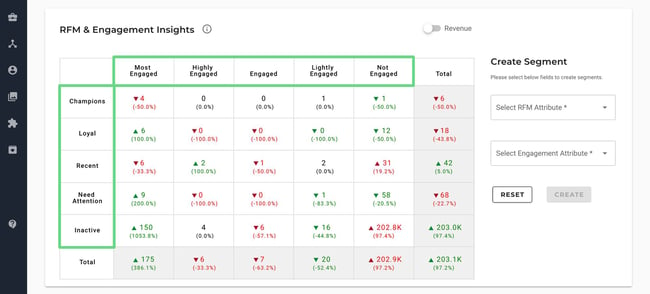
Once customers are grouped based on RFM scores, the system also looks at their engagement behavior across website visits, email opens and clicks, and abandoned carts and categorizes them into the following engagement groups:
-
Most engaged
-
Highly engaged
-
Engaged
-
Lightly engaged
-
Not engaged
Now the question is: why does it matter, and how can you use it in your marketing strategy? Imagine a customer, Veronica, who made her last purchase seven months ago, spending $300 on a winter jacket.
With the traditional RFM approach, Veronica would automatically be moved to the "Inactive" segment. The system would then send her a generic "We miss you" email with a 10% discount on jackets that she will likely ignore because it just isn't relevant to her current needs.
But the engagement data reveals that Veronica is actually very active right now, even if she hasn’t checked out yet:
-
Email clicks: She opened your recent newsletter and clicked on linen dresses three times this week.
-
Website visits: She visited your website yesterday, browsed your new linen collection, and spent 4 minutes on a single product page (a $170 midi linen dress).
-
Shopping cart: She added that dress to her cart but didn’t complete the purchase.
Knowing this gives you the opportunity to send highly targeted, personalized campaigns to Veronica, encouraging her to complete the purchase. Here’s what it might look like:
-
The ‘trust builder’ email (60 minutes post-abandon) featuring user reviews of that exact dress to provide social proof.
-
The ‘wardrobe builder’ email (24 hours post-abandon) featuring matching items she clicked on to encourage her to complete her look.
-
The ‘scarcity alert’ SMS (48 hours post-abandon) with a ‘low stock’ alert to trigger an immediate decision.
eRFM segmentation enables you to identify "hidden" high-value customers like Veronica, who may not have purchased recently but are actively signaling their intent through high engagement. With the right personalized campaigns, you can influence their purchase decisions before they drop off and shop elsewhere.
How Maropost Marketing Cloud enables effective customer segmentation and personalized campaigns
Understanding the impact of effective customer segmentation on your bottom line is only half the battle. You also need the right marketing automation tools to build those segments and set up automated, personalized campaigns that keep your customers engaged and drive repeat purchases. And that’s where Maropost Marketing Cloud can help. Here’s how:
Next-generation AI-powered segment builder:
The next-gen AI-powered segment builder makes the process of creating complex customer segments much faster and easier. You can either choose from a variety of pre-built segment prompts or describe your criteria in your own words – and the AI engine will create a segment within seconds based on your description. Then, you can review the results and make quick adjustments if needed to ensure you’re getting the precision you want.
Advanced segmentation based on eRFM analytics:
With advanced eRFM analytics tools, you can go beyond basic segmentation. It enables you to segment your customers by combining their purchase behavior with engagement signals. Armed with these insights, you can run more targeted marketing campaigns tailored to each segment to increase engagement, improve customer retention, and increase revenue from your marketing strategy.
Dynamic content and recommendations for personalized campaigns:
Maropost Marketing Cloud lets you create more relevant and personalized email campaigns by automatically displaying different content blocks to different segments within the same email template based on location, interests, customers’ behavior, or other criteria. In addition, you can also include dynamically generated product recommendations in your email campaigns aligned with shoppers’ interests and past purchases to increase conversions and AOV.
Book a demo now to see Maropost Marketing Cloud in action and learn how it can help you segment your customer base effectively and engage customers across the entire journey with personalized, cross-channel campaigns that drive revenue.