
The best email marketing platforms for ecommerce in 2026 are Maropost Marketing Cloud (Maropost's platform for email, SMS, marketing automation, and ad campaigns), Klaviyo, Mailchimp, Omnisend, and Braze — each suited to different business sizes and sending volumes. This guide compares all five side by side so you can pick the right email marketing platform for your store.
We evaluated each tool on deliverability, segmentation, automation, ecommerce integrations, scalability, and pricing model. For platform details and Maropost pricing, see our product pages. For head-to-head breakdowns, we also publish Maropost vs competitor comparison guides — use the table below for a quick overview, then jump to a deep dive where you need more detail. Already on Mailchimp and evaluating a switch? Start with our Mailchimp alternatives for ecommerce (2026) guide.
Last updated: June 2026
Our pick for high-volume ecommerce: Maropost Marketing Cloud — Maropost's marketing platform for email, SMS, automated campaigns, and Meta ads in one place, with pay-per-send pricing (not per-contact), eRFM segmentation, ~98% deliverability (stated by Maropost), and unified commerce. Compare in depth: Maropost vs Klaviyo, Maropost vs Mailchimp, or all Maropost vs competitor guides.
Key takeaways
- In 2026, the best email marketing platforms for ecommerce depend on deliverability, behavior-based personalization, and how pricing scales as your list grows.
- Prioritize granular segmentation, strong deliverability, AI automation, advanced analytics, and a pricing model that stays predictable at higher volume.
- Our top five for ecommerce in 2026: Maropost Marketing Cloud (email, SMS, automation & ads — high-volume & enterprise), Klaviyo and Omnisend (mid-market), Mailchimp (SMBs), and Braze (enterprise multi-channel).
- Maropost Marketing Cloud is Maropost's all-in-one marketing platform — not a generic industry term — for email marketing, SMS, automated journeys, and Meta ad campaigns, plus eRFM segmentation and unified commerce for fast-growing brands.
Quick comparison: top 5 email marketing platforms for ecommerce
| Platform | Best for | Deliverability | Pricing model | Standout feature |
|---|---|---|---|---|
| Maropost Marketing Cloud Email, SMS, automation & ad campaigns |
Fast-growing & enterprise ecommerce, high-volume senders | ~98% (stated by Maropost) | Pay per email sent | eRFM segmentation + deliverability support |
| Klaviyo | SMB–mid-market ecommerce, deep store integrations | Strong; deliverability support | Per active profile | Shopify-style integrations + predictive analytics |
| Mailchimp | Small ecommerce, simple campaigns | Mixed; deliverability complaints common | Per contact | Easy setup + free tier to start |
| Omnisend | SMB–mid-market, quick ecommerce launches | Solid for typical ecommerce volume | Free plan; scales with usage & SMS | Pre-built ecommerce workflows & templates |
| Braze | Enterprise, multi-channel engagement | Enterprise-grade infrastructure | Custom enterprise pricing | Email, SMS, push, in-app & more in one platform |
Quick picks: Maropost for high-volume ecommerce; Klaviyo or Omnisend for mid-market; Mailchimp for beginners; Braze for enterprise multi-channel. Outgrowing Mailchimp? See Mailchimp alternatives for ecommerce (2026).
Click a platform in the table or scroll to the full reviews below. Evaluating Maropost against a specific vendor? Skip to our Maropost vs competitor comparison guides.
Top 5 email marketing platforms for ecommerce: full reviews (2026)
We focus on five platforms that cover the full range of ecommerce email needs — from starter stores to enterprise senders. Each review covers core features, pros and cons, and who it fits best. For feature-level Maropost comparisons, use the matching page in our Maropost vs competitor guides section below.
1. Maropost Marketing Cloud
What is Maropost Marketing Cloud? It is Maropost's all-in-one marketing platform for ecommerce brands — not a vague "marketing cloud" label. You use it to run email marketing, SMS campaigns, automated marketing journeys, and paid ad campaigns (including Meta ads) from a single system, alongside segmentation, analytics, and deliverability tools.
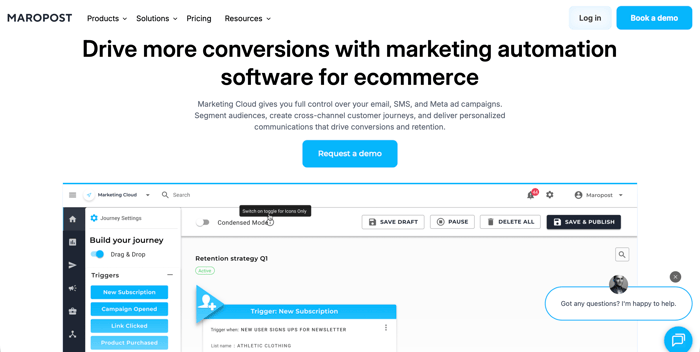
Maropost Marketing Cloud is built for fast-growing ecommerce brands with high-volume sending needs. Unlike platforms that bill based on active profiles, Maropost charges based on emails you send, not the number of contacts you store — helping you avoid cost spikes as your list grows. From one platform you can send promotional and transactional email, trigger SMS messages, build visual customer journeys, launch Meta ad campaigns, and segment audiences using advanced eRFM reporting for more personalized, retention-focused marketing.
Core features:
- Email marketing campaigns (promotional & transactional)
- SMS marketing campaigns
- Meta (Facebook & Instagram) ad campaigns
- Visual customer journey builder & marketing automation
- Cross-channel campaigns (email + SMS + ads)
- AI-powered segment builder
- Advanced segmentation with eRFM reporting
- Dynamic landing pages
- Dynamic content and AI product recommendations
- Send-time and conversion-time optimization
- A/B testing campaigns
- Deliverability support and remediation
- One-click third-party integrations
- Unified customer profiles
| Pros | Cons |
|---|---|
|
|
Best for: Fast-growing ecommerce businesses (mid-market and enterprise) with high-volume sending needs.
Comparing Maropost to another platform? See our full Maropost vs competitor guides — including Klaviyo, Mailchimp, Omnisend, Braze, and more.
2. Klaviyo
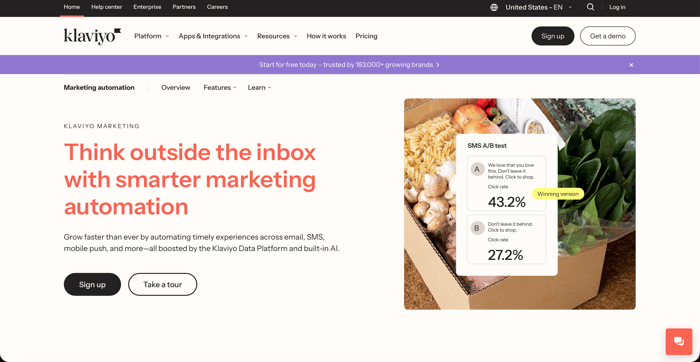
Klaviyo is a popular email marketing platform for ecommerce, known for deep integrations with Shopify, BigCommerce, WooCommerce, and Magento, plus eRFM and predictive analytics. It supports highly targeted campaigns based on purchase behavior and engagement. Klaviyo's pricing is based on active profiles, so monthly costs can rise quickly as your contact list grows.
Core features:
- Email and SMS campaigns
- Generative AI for content creation
- Visual journey builder
- AI segment builder
- Dynamic content and product recommendations
- A/B testing campaigns
- Deliverability support
- eRFM analytics and predictive insights (added cost)
- Product reviews (added cost)
- Strong integrations with ecommerce platforms
| Pros | Cons |
|---|---|
|
|
Best for: Small to mid-sized ecommerce businesses that need advanced segmentation and deep personalization.
Deep dive: Maropost vs Klaviyo — feature comparison
Also see: Top Klaviyo alternatives for ecommerce businesses in 2026
3. Mailchimp
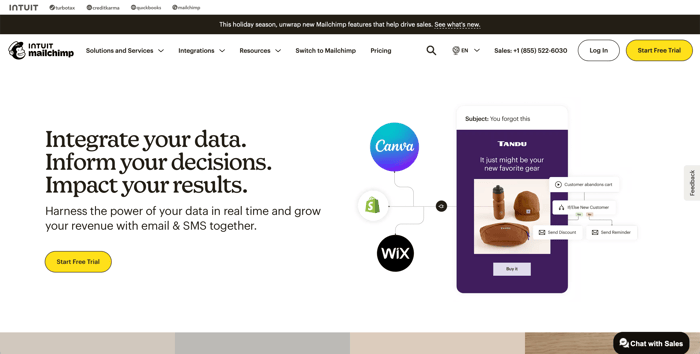
Mailchimp is one of the most recognized email marketing platforms. Many ecommerce brands start here because it's easy to set up and offers SMS and social tools beyond email. Like Klaviyo, Mailchimp charges per contact, so costs can escalate as your list grows, and advanced ecommerce features are limited compared to dedicated platforms. If you're actively comparing replacements, see our Mailchimp alternatives for ecommerce (2026) — or the Maropost vs Mailchimp feature comparison.
Core features:
- Email and SMS campaigns
- Generative AI for campaign creation
- Pre-built and custom-coded templates
- Forms and landing pages
- Dynamic content and product recommendations
- A/B testing campaigns
- Send-time optimization
- Advanced segmentation
- Custom reporting
- One-click integrations with third-party tools
| Pros | Cons |
|---|---|
|
|
Best for: Small ecommerce businesses with straightforward email marketing needs.
Deep dive: Maropost vs Mailchimp — which platform is best for growth?
Also see: Mailchimp alternatives for ecommerce (2026) — Maropost, Klaviyo, Omnisend, ActiveCampaign & Moosend compared
4. Omnisend

Omnisend is built for ecommerce and integrates with Shopify, BigCommerce, and WooCommerce. It's a strong option for small and mid-sized teams that want to launch quickly, with ready-made templates, generative AI for content, and pre-built ecommerce automation workflows.
Core features:
- Cross-channel campaigns (email, SMS, push notifications)
- Generative AI for email content creation
- Dynamic content blocks
- Personalized product recommendations
- Pre-built ecommerce workflows and templates
- Sign-up forms and landing pages
- A/B testing campaigns
- Advanced segmentation
- Sales and performance reports
- Third-party integrations and APIs
| Pros | Cons |
|---|---|
|
|
Best for: Small to mid-sized ecommerce businesses that want easy email and SMS with ready-made workflows.
Deep dive: Maropost vs Omnisend — email marketing comparison
5. Braze

Braze is a customer engagement platform — not just email software — supporting email, SMS, web, mobile app, WhatsApp, and digital ads. It suits larger teams with developer resources; setup and complex automations can be demanding. Pricing is custom enterprise-level.
Core features:
- Cross-channel campaigns (email, web, mobile push, SMS, WhatsApp)
- Visual journey builder (drag-and-drop editor)
- Pre-built email templates
- Generative AI for content creation
- Dynamic content and product recommendations
- AI agents for workflow automation
- A/B testing tools
- Flexible segmentation
- Advanced analytics and reporting
- Third-party integrations and APIs
| Pros | Cons |
|---|---|
|
|
Best for: Enterprise ecommerce businesses with multi-channel messaging needs.
Deep dive: Maropost vs Braze — email marketing platform comparison
Maropost vs competitor: full comparison guides (2026)
Need more than a summary review? These pages compare Maropost Marketing Cloud — Maropost's email, SMS, automation, and ad campaign platform — feature-by-feature against other email and engagement platforms, including segmentation, automation, deliverability, integrations, and pricing models. We published these guides recently so you can go deep on any vendor on your shortlist. For a neutral shortlist of Mailchimp replacements (not just Maropost), see our Mailchimp alternatives for ecommerce (2026) blog.
- Maropost vs Klaviyo — feature comparison
- Maropost vs Mailchimp — which platform is best for growth?
- Maropost vs Omnisend — email marketing comparison
- Maropost vs Braze — email marketing platform comparison
- Maropost vs SendGrid — driving revenue growth with email marketing
- Maropost vs Emarsys — deep comparison of email marketing features
- Maropost vs Iterable — email software compared
- Maropost vs Listrak — email marketing compare
- Maropost vs MoEngage — email marketing comparison
What to look for when choosing an email marketing platform for ecommerce
Dozens of email marketing tools claim to be the perfect fit. These are the capabilities that separate platforms built for real ecommerce scale from basic senders:
- Granular segmentation: Customer segmentation by purchase history, location, and real-time behavior — essential for diverse catalogs and international stores.
- Strong deliverability: Email deliverability can make or break your strategy. A strong platform typically achieves 92–95% inbox placement; look for deliverability tooling and support, not just sending volume.
- AI and automation: Meaningful AI for segmentation, journey building, content, and analysis — not just a marketing label on basic rules.
- Email personalization: Personalized emails drive significantly more sales than generic sends. Look for dynamic content, product recommendations, and send-time optimization — not just first-name merge tags.
- Reporting and analytics: Track the email marketing metrics and KPIs that matter, including eRFM-style insight into purchase behavior and lifetime value.
- Reliability and scalability: Can the platform handle large contact databases and high-volume sending without performance drops?
- Predictable pricing: Per-contact pricing can spike as lists grow (including inactive contacts). Compare pricing models on our pricing page and factor in how each platform scales with your business.
Why Maropost Marketing Cloud stands out for ecommerce email
Maropost Marketing Cloud is more than an email tool — it is Maropost's full marketing platform for email, SMS, automation, and ad campaigns. Here's where it fits for ecommerce brands:
- Advanced segmentation with eRFM reporting: Combine purchase behavior with engagement signals for more relevant, timely campaigns.
- 98% deliverability rate: Adaptive delivery, sender reputation management, real-time reporting, and dedicated deliverability support (as stated by Maropost).
- AI-powered personalization: Dynamic content blocks and product recommendations based on each shopper's behavior.
- Send-time and conversion-time optimization: Reach contacts when they're most likely to open — and convert.
- Enterprise-level scalability: Built for large contact databases (500K–1M+ profiles) and high-volume sending.
- Unified commerce: Part of Maropost's unified commerce platform — storefront, orders, marketing, merchandising, and support in one ecosystem.
Explore features on the Maropost email marketing platform page or review pricing options for your use case.
How to choose the right email marketing platform
- Define your send volume and list size — high-volume brands often outgrow per-contact pricing quickly.
- Map required integrations — Shopify, Magento, custom storefront, ERP, or a unified platform like Maropost.
- Prioritize deliverability and support — especially if you're sending promotional and transactional email at scale.
- Compare pricing models — per contact, per active profile, per email sent, or custom enterprise (see each platform's pricing model in the table above).
- Read head-to-head comparisons — use our Maropost vs competitor guides if Maropost is on your shortlist.
- Run a shortlist trial — test segmentation, automation, and reporting with a real campaign before committing.