

Mailchimp has been around for a while, helping businesses handle email marketing — especially for small lists and simple newsletters. But it isn’t the right platform for every growing ecommerce brand.
If limited automation, deliverability gaps, per-contact pricing, or slow support have you searching for alternatives, you’re not alone. In 2026, the best Mailchimp alternatives for ecommerce combine strong automation, inbox placement, and pricing that scales with sends — not just list size.
In this guide we compare the top 5 Mailchimp alternatives (Maropost Marketing Cloud, Omnisend, Klaviyo, ActiveCampaign, and Moosend), plus a detailed Maropost vs Mailchimp breakdown. For the full platform landscape, see our best email marketing platforms for ecommerce comparison. Need feature-level detail on Maropost? Read the deep dive: Maropost vs Mailchimp.
Our pick for ecommerce brands outgrowing Mailchimp: Maropost Marketing Cloud — pay-per-send pricing, ~98% deliverability (stated by Maropost), eRFM segmentation, and email + SMS + Meta ads in one platform. Compare in depth on our Maropost vs Mailchimp page or see Maropost pricing.
Last updated: June 2026
TL;DR
- While Mailchimp once dominated due to affordability, its growing limitations are driving many users to consider more capable alternatives.
- Users often switch from Mailchimp because of inefficient billing model, limited automation capabilities, deliverability issues, and slow support.
- Top 5 Mailchimp alternatives to consider in 2026 include Maropost Marketing Cloud, Omnisend, Klaviyo, ActiveCampaign, and Moosend, offering better value for money.
- Maropost Marketing Cloud (Maropost’s platform for email, SMS, automation, and ad campaigns) delivers higher deliverability, deeper insights, and more scalability than Mailchimp for growing ecommerce brands.
Why should you consider a Mailchimp alternative?
There might be various reasons why users might choose to step away and look for alternative email services like Mailchimp. So first things first, let’s take a look at the most common ones (based on user reviews):
- Pricing and billing structure: Mailchimp has increased its pricing several times over the past years, often without adding significant new value. As of today, it can be up to 6x more expensive than its alternatives. Beyond that, costs can quickly start to add up as your contact list grows because Mailchimp charges you for every contact, including duplicates across multiple lists, inactive contacts, and unsubscribed users.
- Limited automation: While Mailchimp does offer basic automation tools, it falls short for businesses needing more advanced automation capabilities like behavior-based triggers, multi-step workflows, dynamic landing pages, and advanced A/B testing tools.
- Deliverability issues: With Mailchimp, users often face deliverability issues (i.e., emails landing in spam/ promotions rather than inboxes). Based on independent research, Mailchimp’s email deliverability rates have varied from 82% to 95% over the past decade. This suggests that nearly 1 in every 10 emails might not reach the intended inbox. Users often attribute Mailchimp’s deliverability problems to shared or overused IPs.
- Customer support quality: When it comes to customer support, users have been reporting slow response times and less personalized assistance (especially with lower-tier plans) compared to some Mailchimp competitors. While this may not seem critical at first, for businesses that rely on quick support (e.g., for deliverability issues, contact list problems, or campaign errors), poor support can be a deal-breaker.
Top 5 Mailchimp alternatives in 2026 and how they compare
|
Mailchimp Alternatives |
Standout Features |
Best for |
Free Plan |
|---|---|---|---|
| Maropost Marketing Cloud |
|
Mid-market to enterprise-grade ecommerce and retail brands, high-volume senders, businesses needing multi-channel marketing orchestration | No |
| Omnisend |
|
Small to mid-sized ecommerce brands looking for a budget-friendly email marketing platform | Yes |
| Klaviyo |
|
Ecommerce brands that rely on repeat purchases, lifecycle marketing, and personalized customer journeys | Yes |
| ActiveCampaign |
|
Small to mid-sized businesses, ecommerce stores, or growing companies that want a single platform for marketing, sales, and CRM | No |
| Moosend |
|
Small businesses that want basic email marketing automation with minimal overhead | Yes |
1. Maropost Marketing Cloud
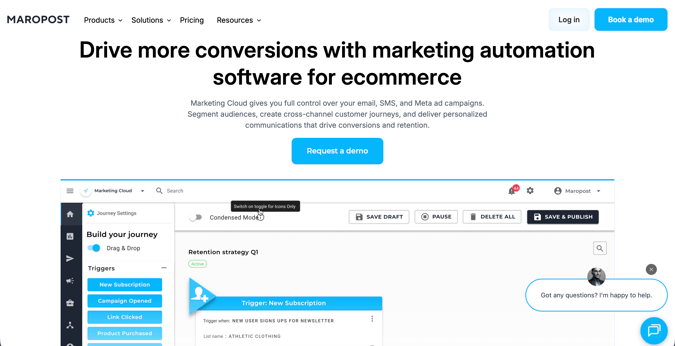
What is Maropost Marketing Cloud? It is Maropost’s all-in-one platform for email marketing, SMS, automated campaigns, and Meta ad campaigns — not a generic “marketing cloud” label. Maropost Marketing Cloud is a compelling Mailchimp alternative for mid-market ecommerce and retail brands that have outgrown basic newsletters and need deeper automation, stronger deliverability, and pay-per-send pricing. Maropost’s eRFM reporting lets you segment customers by value and engagement for retention-focused campaigns. Full comparison: Maropost vs Mailchimp.
Key features:
- Cross-channel campaigns (emails+SMS+Meta ads)
- Unlimited users, contacts, lists, and journeys with the Enterprise plan
- Dynamic landing pages + a drag-and-drop page builder
- AI-powered product recommendations
- Send-time and conversion-time optimization
- Advanced customer segmentation with eRFM reporting
- A/B testing campaigns
- One-click third-party integrations
- Access to a dedicated deliverability support team
- 24/7 chat support across all plans
| Pros | Cons |
|---|---|
|
|
Best for: Mid-market to enterprise-grade ecommerce and retail brands, high-volume senders, businesses needing complex, multi-channel marketing orchestration.
2. Omnisend
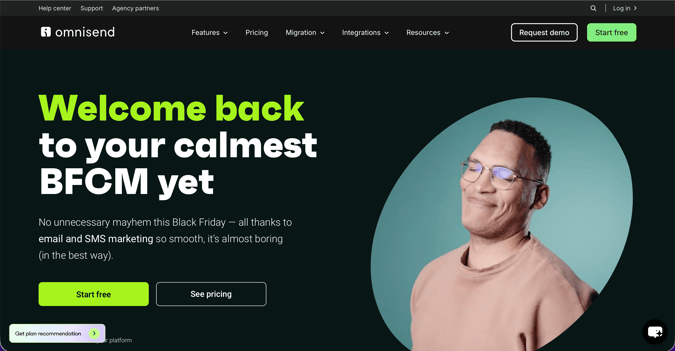
Omnisend is an email marketing software built specifically for ecommerce businesses. It combines email, SMS, and push notifications into unified workflows and offers lots of built-in ecommerce features (like dynamic product recommendations and discount-code insertion). Compared to Mailchimp, Omnisend delivers more value for online stores: its automation and multi-channel capabilities are more advanced by default, and even free/entry-level plans unlock segmentation and ecommerce-specific automations.
Key features:
- Unlimited monthly emails with higher-tier plans
- Cross-channel campaigns (email+SMS+push notifications)
- Popups, signup forms, and landing pages
- Behavior-based segmentation
- Contact list cleaning tool
- Personalized product recommendations
- Sales and performance reporting
- A/B testing and automation splits
- Pre-built integrations and APIs
- 24/7 live chat and email support
| Pros | Cons |
|---|---|
|
|
Best for: Small to mid-sized ecommerce brands looking for a budget-friendly ecommerce email marketing tool.
3. Klaviyo
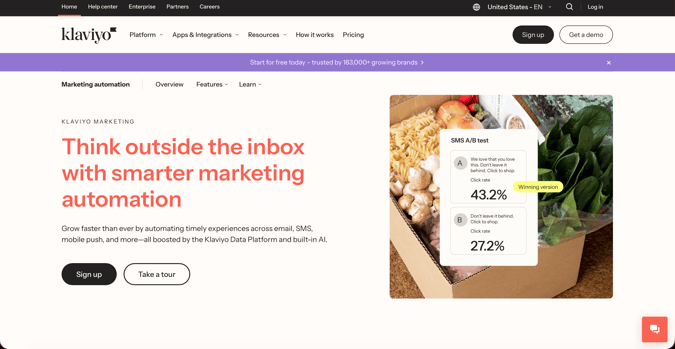
Klaviyo is also built specifically for ecommerce businesses. It offers advanced segmentation, event-triggered automation, and predictive analytics that let you send highly personalized email/ SMS campaigns based on customer behavior. Unlike Mailchimp’s basic reporting, Klaviyo provides stronger insights into revenue, customer lifetime value, and lifecycle-based marketing performance, making it a better choice for growing online stores that care about ROI.
Key features:
- Email and SMS campaigns
- Generative AI for faster content creation
- Multi-channel segmentation
- Product recommendations
- Multi-channel A/B testing
- Email deliverability score
- Customer profiles with all-time data
- Product reviews (added cost)
- Predictive analytics and advanced reporting
- Built-in integrations with third-party tools
| Pros | Cons |
|---|---|
|
|
Best for: Ecommerce brands that rely on repeat purchases, lifecycle marketing, and personalized customer journeys.
Recommended reading: Top 5 Klaviyo alternatives for ecommerce businesses in 2026
4. ActiveCampaign
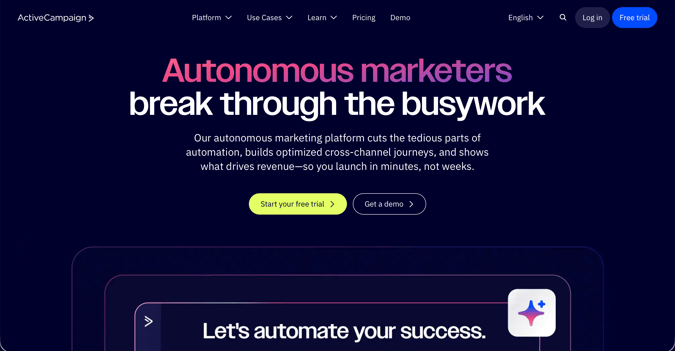
Compared to Mailchimp, ActiveCampaign is a more full-featured and advanced platform that actually goes beyond marketing automation. It combines email marketing, advanced segmentation, and an integrated CRM, letting you build complex, behavior-driven customer journeys, trigger cross-channel messages, and do lead scoring and deal tracking in one place. Ultimately, this makes ActiveCampaign more expensive than Mailchimp, but also significantly better for businesses that want more flexibility and scalability.
Key features:
- Email, SMS, WhatsApp messaging campaigns
- Landing page builder
- AI-powered automation builder
- Generative AI with higher-tier plans
- A/B testing tools
- Predictive sending
- Advanced segmentation
- Conversions tracking and revenue reporting
- Marketing CRM
- Extensive library of third-party integrations
| Pros | Cons |
|---|---|
|
|
Best for: Small to mid-sized businesses, ecommerce stores, or growing companies that want a single platform for marketing, sales, and CRM.
5. Moosend
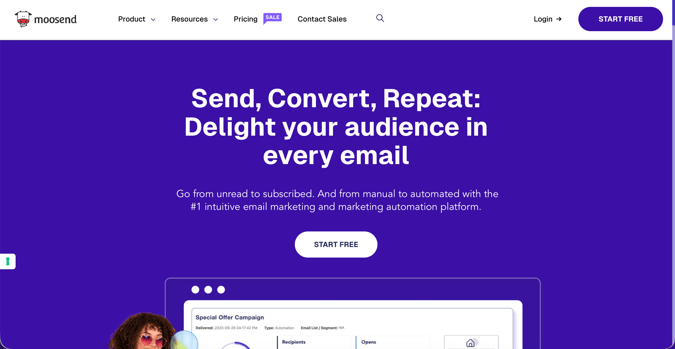
Moosend is a budget-friendly email marketing platform that gives many of the essentials you’d expect from a larger system. Compared to Mailchimp, Moosend often wins on affordability and simplicity. Its drag-and-drop builder, basic automation workflows, list segmentation, and reporting make it especially attractive for small businesses or marketers new to email campaigns. Moosend is a great fit if you want straightforward email marketing – it’s easy to set up, easy to run, and cost-effective.
Key features:
- Unlimited email campaigns/ sends
- Marketing automation workflows
- Automation builder and email templates
- Landing pages and forms
- Email newsletter builder
- AI-powered product recommendations
- Custom reporting
- A/B testing capabilities
- Deliverability optimization with the Enterprise plan
- Third-party integrations and API access
| Pros | Cons |
|---|---|
|
|
Best for: Small businesses that want a basic email marketing service with minimal overhead.
Maropost Marketing Cloud vs Mailchimp: what’s the right solution for your business?
Mailchimp is widely recognized — but it isn’t the right tool for every growing ecommerce brand. Below is a summary comparison; for the full feature-by-feature deep dive (pricing models, deliverability, automation, integrations, and verdict), use our dedicated page: Maropost vs Mailchimp comparison.
Maropost Marketing Cloud vs. Mailchimp at a glance
|
Maropost Marketing Cloud |
Mailchimp |
|
|---|---|---|
| Email campaigns | ||
| SMS campaigns | ||
| Transactional emails | Paid add-on | |
| A/B testing | ||
| Send-time optimization | ||
| Conversion-time optimization | ||
| Deliverability rate | 98% | 82%-95% |
| Deliverability report | ||
| Access to deliverability support team | Across all plans | With higher-tier plans |
| Visual journey builder | ||
| Automated journeys (flows) | Unlimited with the Enterprise plan | Up to 200 flow steps |
| Landing page builder | ||
| Dynamic landing pages | ||
| Dynamic content | ||
| Product recommendations | ||
| Unlimited lists | ||
| Advanced segmentation | ||
| eRFM analytics | ||
| Custom reports | ||
| Unified contacts | ||
| One-click integrations | ||
| 24/7 customer support | ||
| Dedicated customer success manager | ||
| Dedicated onboarding |
Maropost Marketing Cloud vs. Mailchimp: pricing model
Mailchimp’s pricing model charges per contact (even duplicates or inactive ones), which can become pretty costly as your list grows. It basically means that if one customer appears in two different lists, you’ll have to pay twice. With Maropost Marketing Cloud, you pay for the emails you send – not for how many contacts you store in your database. No wasted spend.
Maropost Marketing Cloud vs. Mailchimp: deliverability
Maropost Marketing Cloud is known for excellent email deliverability. While Mailchimp’s deliverability rate typically ranges between 82% and 95%, Maropost Marketing Cloud ensures a 98% deliverability rate on your email marketing campaigns by using adaptive sending technology, maintaining a high-trust sender environment, providing real-time deliverability analytics, and offering dedicated deliverability support and remediation. Inbox placement is one reason teams switch—see how it fits into the full Maropost email marketing platform.
Maropost Marketing Cloud vs. Mailchimp: engagement-based analytics
While Mailchimp does allow you to track basic campaign performance metrics and purchase behavior with the ecommerce integration, Maropost goes a lot further than that. With Maropost’s eRFM reporting, you can see your customers grouped by recency, frequency, and monetary value, as well as their engagement patterns. These insights make it easier for you to target the right groups with specific campaigns and improve personalization and retention.
Maropost Marketing Cloud vs. Mailchimp: scalability
Mailchimp scales well for small to mid-sized businesses. It can comfortably handle growing subscriber lists from a few hundred to tens or even hundreds of thousands. But Maropost Marketing Cloud is built from the ground up for enterprise-level scalability. It can easily handle massive contact databases and high-volume sending without any drop in performance. Maropost’s infrastructure is optimized for speed and deliverability at scale.
Maropost Marketing Cloud vs. Mailchimp: customer support
Users on G2 frequently point out the higher quality of support they receive from Maropost, which holds a 9.0 rating compared to Mailchimp’s 8.0. Many note that Maropost’s responsive and knowledgeable customer service team is a real advantage, especially for businesses that need immediate help.
Maropost Marketing Cloud vs. Mailchimp: beyond marketing automation
Mailchimp is a solid marketing automation platform, but ultimately, it’s just that – a tool built to help small businesses automate their email and SMS campaigns. Maropost goes far beyond that. Marketing Cloud is part of the Maropost Unified Commerce platform – a solution that lets you run your marketing, ecommerce, merchandising, and customer support from one system – eliminating the chaos of juggling disconnected tools.
Book a demo to see Maropost Marketing Cloud in action, or explore Maropost pricing and the full Maropost vs Mailchimp comparison.