
If you think that search abandonment – when shoppers search for a product on your ecommerce website but don’t find what they’re looking for – isn’t a big deal, think again. According to Google Cloud’s data, search abandonment costs retailers over $2 trillion annually worldwide, and more than $234 billion in the United States alone.
Moreover, 78% of US consumers view a brand differently after experiencing search difficulties, and 82% avoid websites where they’ve experienced search difficulties in the past.
The truth is, today’s consumers expect website search engines to understand their intent (even when their searches are vague), return highly relevant results, and help them find what they’re looking for effortlessly. And if your ecommerce website isn’t delivering that search experience, you’re most probably missing a ton of sales opportunities.
Fortunately, implementing an AI-powered ecommerce search can help you reduce search abandonment, convert more online shoppers, and drive higher revenue by simply helping users find what they want faster and more effortlessly. In this blog, we’ve covered everything you need to know about AI-powered site search in 2026 and why it can be a game-changer for your ecommerce business.
TL;DR
- Search abandonment costs retailers over $2 trillion annually worldwide, including more than $234 billion in the United States alone.
- AI-powered search is a smarter site search that understands intent and context – not just exact keywords – to deliver more relevant, personalized search results.
- Traditional ecommerce search often fails shoppers by delivering irrelevant results, which creates a frustrating experience and missed conversion opportunities.
- The benefits of AI-powered search include improved user experience and customer retention, higher conversion rates, and increased revenue from existing traffic.
- Maropost Merchandising Cloud goes beyond AI-powered search by offering smart collections, real-time data sync, product recommendations, multilingual support, and a unified commerce platform.
What is AI-powered site search in ecommerce?
AI-powered site search is an intelligent search technology that helps shoppers find the right products faster whenever they are using a website search bar by understanding intent and context, not just exact keywords. So, instead of browsing product listings and using filters to find the items they need, it allows shoppers to type what they are looking for in a search bar and get relevant results.
Unlike traditional site search, AI-powered site search uses artificial intelligence, machine learning, and natural language processing to handle misspellings, recognize synonyms, and understand conversational queries to return relevant search results.
For example, think about the following scenarios:
- Synonyms: There are many ways of saying the same thing. Sneakers and running shoes basically mean the same. AI-powered search understands that shoppers typing “sneakers” or “trainers” are looking for the same type of product.
- Typos or misspellings: Product names aren’t always easy to spell. If a shopper types “sneekers” instead of “sneakers,” AI-powered search can still understand what they mean and return the right products.
- Descriptive search: Shoppers don’t always search by exact product names. A shopper might type “lightweight running shoes for long distances” or “shoes for trail running,” and AI-powered site search understands the intent behind those descriptions.
- Attribute-based intent: Instead of using filters, a shopper might type “black sneakers under $200.” AI-powered search can interpret multiple attributes in a single query and return relevant results.
- Out-of-stock products: If a shopper searches for a product that’s currently unavailable, AI-powered search can automatically promote similar or alternative items instead of showing a dead end.
But what really sets AI-powered site search apart is its ability to analyze shopper behavior and deliver highly personalized search experiences, while continuously improving relevance over time as it learns from past interactions.
AI-powered site search helps ecommerce and retail merchants improve product discovery, reduce zero-result searches, and increase conversion rates and average order value (AOV).
The problem with the traditional site search and what frustrates shoppers most
Many ecommerce brands still rely on default site search. In reality, it means that unless a shopper types the exact words from your product catalog, they’ll get either irrelevant or zero results, which creates a frustrating experience and missed conversion opportunities.
According to research from Nosto, here are the shoppers’ top frustrations with ecommerce site search:
| 41% | Too many irrelevant results are shown |
| 32% | When products are shown in the results despite being out of stock |
| 30% | Not being able to narrow down search results with filters |
| 27% | Results taking too long to load |
| 26% | When the search bar can’t interpret my queries or request |
| 23% | When products are shown but not available in my size |
But while over 80% of surveyed brands understand the importance of efficient site search and agree that fast, accurate search is essential for a successful ecommerce store, many are still missing key search functionality needed to make that happen.
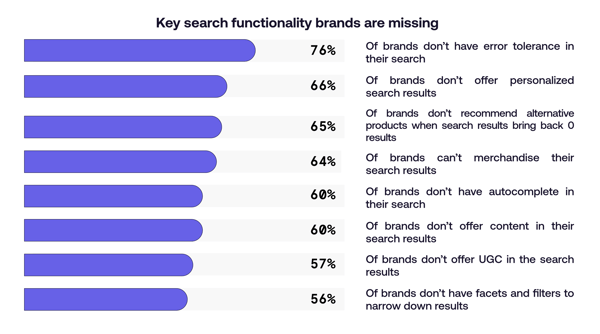
Image source: Nosto
What are the benefits of implementing AI-powered site search?
Let’s now take a closer look at the specific benefits you get when your ecommerce site search becomes more advanced and intelligent:
Improve user experience and customer retention
Statistically, 43% of online shoppers head straight for the search bar upon landing on an ecommerce site. When site search returns highly relevant results, and shoppers can instantly find what they’re looking for, user experience improves and – more importantly – shoppers are more likely to return.
According to Google Cloud, nearly 9 in 10 consumers (88%) say a good search function is very important or absolutely essential when visiting a retail website. On top of that, 99% are more likely to return to a website if it has a good search function. At the same time, 3 out of 4 consumers report that after an unsuccessful search, the sale is often lost to competition.
Turn more website visitors into real conversions
Based on the Site Search Industry Benchmark report from Prefifbox and Salesforce, although only 16% of shoppers use the search function on ecommerce websites, they generate 55% of all online revenue. This means that site search users are 6.4 times more likely to convert (generate revenue). That’s because shoppers who search have a stronger purchase intent – they’re looking for specific products, and they know exactly what they want. And since AI-powered search enables better product discoverability, it helps you convert more searchers.
Generate more sales from your existing traffic
Finally, implementing AI-powered search on your ecommerce site enables you to generate more revenue from the traffic you already have by turning casual visitors into buyers more effectively. In other words, the same number of your website visitors can generate significantly more sales simply because they are able to find relevant products faster and with less friction – all without you having to spend extra on acquisition.
Real-world example:
Wall Tools, a global U.S.-based supplier of professional drywall tools, is a great example of what AI-powered search can deliver. After rolling out Maropost’s Merchandising Cloud, the brand saw a 15% year-over-year lift in conversions. And with faster, more intuitive search, repeat customers now account for more than 50% of their total sales.
“If you aren’t listening to your customers when they talk to you through your search bar, you’ll eventually lose them to someone who does. That search bar is a communication between your customer and you.” — Sacha Dent, Marketing Director, Wall Tools.
Check out the full case study on Wall Tools' search transformation
Do I really need an AI-powered search engine on my ecommerce website?
To determine whether you actually need to implement an AI-powered search on your ecommerce website, ask yourself the following questions:
- Can your shoppers find products using natural variations in spelling or terminology?
- Does your search understand local context and intent, or does it just match keywords?
- Does your search surface relevant alternatives when an item is out of stock?
- Does your search adapt results based on a shopper’s browsing or purchase history?
- Can your search engine learn from past searches that led to purchases and improve over time?
If you answered “no” to any of these questions, your website search experience could be costing you significant revenue – so it might be the right time to give an AI-powered search engine a try.

Maropost Merchandising Cloud’s advantage: beyond AI-powered search
Advanced, AI-powered site search can be the next big step in turning more website searches into conversions and driving higher online sales for your ecommerce business. And Maropost Merchandising Cloud helps you do exactly that, with features and capabilities that go beyond AI-driven search. Here’s what you get with Merchandising Cloud:
- Personalized search: Features like autocomplete prediction, natural language processing (NLP), and spelling tolerance ensure shoppers always get relevant results even with typos or imprecise queries. Better yet, AI-driven personalized ranking continuously learns from behavior to boost conversion-likely products to the top of search results.
- Smart collections: Smart Collections create dynamic, personalized category pages that typically outperform static, out-of-the-box listings. By applying the same AI-powered filtering, machine learning ranking, and personalization from search to your collection pages, it helps customers discover products that match their unique preferences instead of showing them a one-size-fits-all product list.
- Active Sync: Active Sync keeps product data continuously updated by automatically syncing pricing, inventory, and product details in real time. This helps ensure shoppers always see accurate, current product information, which is particularly crucial during high-traffic sales periods when outdated prices or stock levels can impact conversion.
- AI product recommendations: AI product recommendations make it easier for shoppers to discover relevant products – while giving you full control over how products are displayed. By placing recommendation widgets (like “Frequently Purchased Together” or “Recently Viewed Items”) on key pages across your site, you can encourage more cross-sells, inspire more conversions, and increase AOV.
- Multi-lingual support: With the support for multiple languages, Merchandising Cloud helps you deliver relevant search results and personalized product discovery to shoppers in their native language, improving the customer experience and conversion potential across international markets.
- Unified commerce platform: Unlike standalone AI-powered search and recommendation engines, Merchandising Cloud is part of Maropost’s Unified Commerce platform that enables you to run your entire ecommerce business (including order management, marketing, and support) from one connected platform, without having to juggle multiple disjointed systems.
Book a demo now to see Maropost Merchandising Cloud in action and learn how it can help you turn your ecommerce website into a more powerful conversion engine.