
As an ecommerce business owner or marketer, you surely know that acquiring new customers is only half the battle. Keeping them for the long term is where your ecommerce growth really happens. Yet, retention has always been one of the biggest challenges for ecommerce businesses – and that’s where customer journey automation can make a difference.
When done right, automating the customer journey helps you deliver timely, contextual, highly personalized experiences that keep your customers engaged long after their first interaction with your brand. In this blog, we’ll explore why customer journey automation is essential for retention and how Maropost Marketing Cloud empowers you to make that happen – strategically and effectively.
TL;DR
- Customer journey automation uses technology to deliver personalized, timely, behavior-triggered interactions that guide customers through their lifecycle.
- Retaining customers is essential because loyal buyers spend more, purchase more often, and account for a large share of your total revenue.
- Customer journey automation improves retention by delivering personalized, timely, and proactive interactions that keep customers engaged and prevent churn.
- Maropost Marketing Cloud enables automated, personalized customer journeys through its visual builder, pre-built templates, behavior-based triggers, dynamic content, product recommendations, and A/B testing tools.
What is customer journey automation?
Customer journey automation is the process of using technology to automatically guide your customers from initial contact to long-term loyalty through a series of personalized, timely interactions – all without manual effort. These interactions are triggered by real-time customer behavior and aligned with each customer’s lifecycle stage, intent, and channel preferences.
So, instead of relying on manual follow-ups and one-size-fits-all messages, automated journeys deliver the right message to the right customer at the right time. Ultimately, it helps you improve customer experience, drive repeat purchases, reduce churn, and maintain loyalty.
What does customer journey automation look like in practice for an ecommerce brand?
Here’s what it might look like an ecommerce brand:
1. Personalized welcome and onboarding flow
Trigger: A new customer signs up or makes their first purchase.
What happens automatically:
- A welcome email sharing your brand story
- A first-purchase thank you message
- A product education email
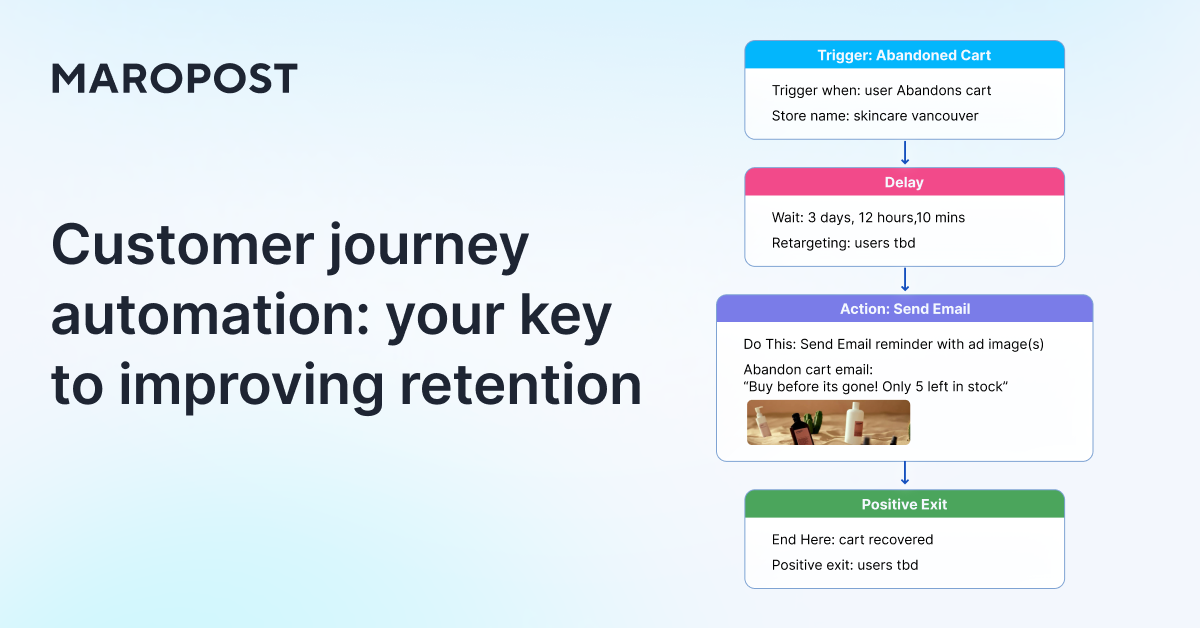
2. Abandoned cart recovery flow
Trigger: A customer adds items to their shopping cart but doesn’t finalize the purchase.
What happens automatically:
- A reminder email or SMS with the abandoned items
- A follow-up email with social prof (customer reviews)
- Timed incentives (discount, free shipping, etc.)
3. Post-purchase follow-up flow
Trigger: A customer places an order.
What happens automatically:
- Order confirmation and shipping updates
- Cross-sell recommendations based on what they purchased
- Care instructions/ tips to get the most out of the product
4. Personalized product recommendations
Trigger: Customer behavior/ purchase patterns
What happens automatically:
- “You might also like” product suggestions
- Replenishment reminders (for consumable products)
- Personalized lookbooks or curated collections
5. Re-engagement flow for inactive customers
Trigger: Customer is inactive for a certain period
What happens automatically:
- Personalized product picks based on past purchases
- “We missed you” messages
- Special offers to encourage repeat purchases
You can get these messages delivered across multiple channels – emails, SMS, push notifications, in-app messages, or social retargeting campaigns. The goal is to keep each customer engaged at every stage of their journey, encourage repeat purchases, and build lasting loyalty.
Recommended: 5 email automation sequences that drive ecommerce success
Why is customer retention critical?
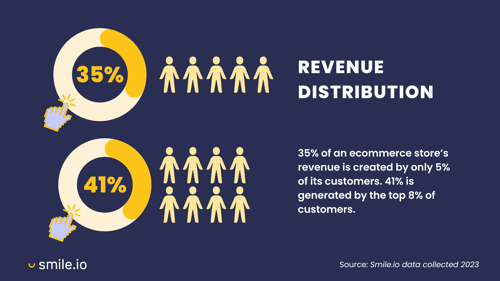
We’ve all heard the classic saying: it costs five times more to acquire a new customer than to retain an existing one. But how does retention really impact your revenue? Here are some compelling stats from Smile.io that show why engaging and nurturing your existing customers pays off far beyond operational savings:
- 41% of an ecommerce store’s revenue comes from just 8% of its customers.
- The top 5% of customers generate 35% of an ecommerce store’s revenue.
- Your loyal top 10% of customers spend 2x more per order than the lower 90%.
- Your top 1% of customers spend 2.5x more per order.
- Getting customers to make a second and third purchase increases their likelihood of buying again to 49% and 62%, respectively.

How does customer journey automation help improve retention?
Customer journey automation is actually one of the most effective marketing strategies for improving customer retention because it shifts the relationship from reactive to proactive and from generic to hyper-personalized. Here’s how exactly customer journey automation drives retention:
- It keeps your customers engaged with highly personalized content: Generic “batch-and-blast” messages often just annoy customers. Automation uses behavioral data (what your customers clicked, what they purchased, how long they’ve been inactive, etc.) to tailor messages. And the more personalized the experience is, the more likely customers are to stick around.
- It strengthens your post-purchase relationships: Customer journey automation helps you deliver a positive, memorable post-purchase experience that makes your customers feel valued and supported after the initial transaction. And that’s definitely a strong foundation for lasting customer satisfaction and loyalty.
- It proactively eliminates the silent churn: Most customers never complain before they leave. They just silently drip away because they feel neglected or forget about your value. Customer journey automation creates a baseline of consistent communication and triggers timely win-back messages before customers disconnect for good.
How Maropost Marketing Cloud enables customer journey automation
Here’s what Maropost Marketing Cloud offers to help you build automated customer journeys and engage your customers at every stage of their lifecycle with highly relevant and timely messages across channels:
Drag-and-drop visual journey builder
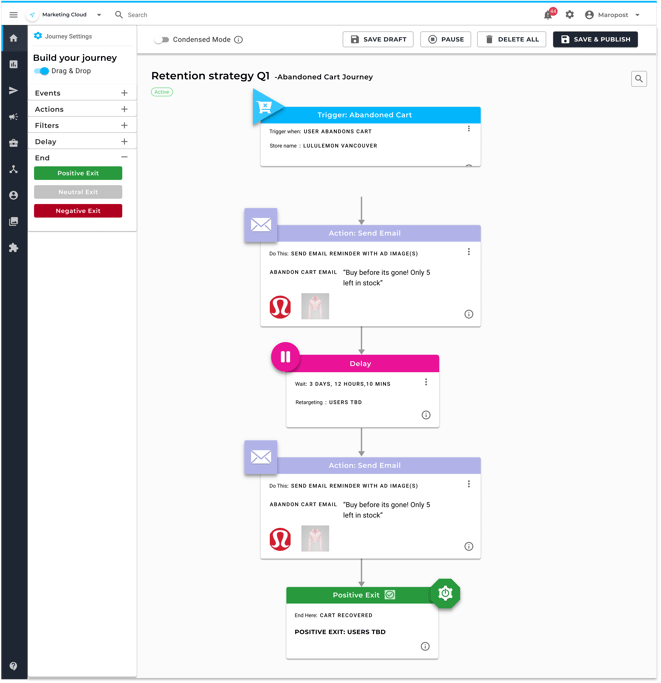
With Maropost’s Journey Builder, you can visually design automated workflows using an intuitive drag-and-drop interface – no coding required. You simply drag "Widgets" onto a canvas to define the flow. These widgets include Triggers (entry points), Actions (e.g., Send email, Send SMS), Filters (for segmentation/branching logic, including A/B splits), and Delays, enabling you to easily map out complex cross-channel sequences.
Behavior-based triggers and segmentation
Maropost automatically triggers journeys based on real customer behavior like website visits, purchases, form submissions, tag changes, inactivity periods, etc. Combined with advanced segmentation and built-in customer intelligence (e.g., eRFM and engagement scoring), the system can identify high-value or at-risk customers and send targeted flows that boost engagement, conversions, and retention.
Pre-built journey templates
With pre-built journey templates, you can quickly set up automated campaigns using industry best practices, reducing setup time and improving performance. No need to build journeys from scratch. Available template types include Welcome, Abandoned Cart, Nurture, Advocacy, Email Re-Engagement, and Lapsed Buyer.
Dynamic content
With Maropost, you can deliver personalized email experiences within a single campaign template. Using Dynamic Tags and Liquid Scripting, you can define "Dynamic Areas" within your email. Based on defined audience segments, contact attributes, or tracked behavior, the system will automatically display different content blocks, dynamic images, or text to each recipient.
Product recommendations
Product recommendations help you create emails that feel more personal and relevant. Instead of manually choosing products for each campaign, the system automatically pulls real-time product suggestions based on what each customer cares about. This helps increase average order value (AOV) and encourage cross-sell or upsell.
A/B testing tools
Maropost makes it easy to A/B test your campaigns and automated journeys so you can quickly see which subject lines, layouts, or calls-to-action actually resonate. And with real-time reporting and analytics, you can fine-tune every workflow based on what’s working, turning data into smarter, higher-performing customer experiences.
Book a demo now to see Maropost Marketing Cloud in action and learn how it can help you automate customer journeys effectively and effortlessly.