

Your ad platform counts a click. Your ESP counts an open. Neither can tell you which one closed the last ten orders, and both will quietly take credit for all of them.
That's where most stores land once four or five channels are running, and the usual next move is to add a sixth. Before you do, work out which of the five you already have deserves more money next month, and which numbers would prove you were right. That answer is already in your order data, not in a new platform.
What is eCommerce digital marketing?
Strip out the channel names and eCommerce digital marketing is fairly simple: put an offer in front of someone who's already online, then prove it produced revenue instead of just a click. The proving is where it gets hard.
It usually plays out like this: someone clicks your paid search ad, looks at three products, leaves without buying, then comes back two days later through an email and checks out. The ad found a stranger and the email closed them, but last-click attribution credits the whole order to email. Next month's budget follows that report.
The two jobs every channel does
That division of labor runs underneath every channel:
- Channels that create the first visit: SEO, AEO, GEO, paid search, paid social, content, and influencer or affiliate programs.
- Channels that turn it into a second one: email, SMS, on-site personalization, and automation.
Most teams already decide well who to reach and which channel carries the message. Deciding which revenue number settles an argument between two channels is the part that goes unowned. Catalog accuracy, inventory, and shipping promises also show up in your conversion rate whether or not marketing gets credit. Send a campaign to an out-of-stock product and you've paid full price to lose the sale at the last step.
Why does eCommerce digital marketing matter?
Ten years ago a store could treat Google as the main discovery channel and build everything else around it. Buyers now arrive through search, social, email, SMS, marketplaces, and AI assistants, often several before a single order. Which creates the problem worth naming: the more places you show up, the harder it gets for any one report to tell you what actually worked.
Two ways to spend when the reports can't tell you
Digital marketing for eCommerce is what you do in spite of that fog. Part of it is buying against named audiences instead of broad reach: past purchasers, high-intent browsers, people who lapsed six months ago. The other part is chasing revenue that already exists in your account, sitting in abandoned carts and one-time buyers who went quiet. Being busy in acquisition is easy; getting paid for it takes a shared customer profile where email and SMS can work the buyers paid search and organic already found.
eCommerce growth marketing
You almost certainly have the channels you need. The open question is whether they're producing better customers over time, and that's what eCommerce growth marketing sets out to answer. It judges your mix on conversion rate, repeat purchase, and customer lifetime value. Traffic and send volume are inputs to those numbers, not a substitute for them.
Symptoms of an allocation problem
If you're already running ads, publishing content, and sending campaigns, another channel is rarely the answer. The constraint is usually data that doesn't move between acquisition, on-site experience, and retention, so nobody can say which dollar of spend created a buyer worth keeping. The symptoms are specific, and you'll recognize at least one:
- You've spent months improving ad targeting while checkout friction went untouched.
- You have a sophisticated cart-recovery program and no post-purchase program at all.
- You're paying to reacquire customers who ordered 30 days ago.
- Your email program only ever sends a promotion.
The four jobs worth running in parallel
All four symptoms are allocation problems, and a practical plan fixes them with four jobs in the same quarter, at different levels of effort:
- Protect paid efficiency. Send product and audience data back into search and social so you're not paying full price to reacquire people who already know the brand.
- Raise conversion on traffic you already paid for. Fix landing pages, merchandising, and checkout friction before spending more on the campaigns that send people there.
- Move more revenue into owned channels. Welcome, cart recovery, post-purchase, replenishment, and win-back should run continuously. A calendar of one-offs won't cover those jobs.
- Measure the path, not the click. A paid click can look expensive on last-click and still be profitable if email and SMS close the second order.
An eCommerce digital marketing strategy names the mix; growth marketing names what the mix should change. An eCommerce digital strategy that skips that second half keeps buying the same customer twice.
Pick one bottleneck per quarter
Choose a single bottleneck and leave the rest alone. Cart recovery as a share of revenue, time to second purchase, or SMS opt-in rate on thank-you pages are each specific enough to staff and small enough to finish. Spread experiments across every channel at once and the quarter ends with a lot of tests and no movement.
eCommerce marketing channels you need to know
Eight channels do most of the work for a store already in market, and your investment across them shouldn't be equal. Email and SMS deserve the largest share, because they carry retention and most of the lifecycle work you can measure. There's evidence for that weighting: Attentive's July 2026 Consumer Pulse surveyed 600 US holiday shoppers who already receive brand email or texts, and among those subscribed to both email and SMS, 22% planned to outspend the previous year against 14% of email-only subscribers. One extra channel of permission, same shoppers and same brands.
Email marketing
eCommerce email marketing returns revenue when it's automated and segmented. If your program only runs on the promotional calendar, it's working a fraction of the hours available to it and missing the moments that actually attach to orders: the welcome window, the refill date, the week after delivery, the point where a good customer stops opening. A weekly send to the full list still has a place for news and merchandising, though it can't recover a cart or time a refill.
The programs that consistently attach to orders
- Welcome. Confirm the opt-in and make a case for a first purchase, or a second if they already converted on-site. A clear offer beats a brand manifesto.
- Browse and cart recovery. Trigger on viewed products and abandoned carts, with inventory and price still accurate at send time. A recovered cart costs less than a new click.
- Post-purchase. Confirm the order, head off support tickets with clear shipping information, then recommend the next relevant item. A full catalog dump is how this program gets ignored.
- Replenishment. For anything bought on a cycle, time the send to the expected run-out date.
- Win-back. Define lapse in your own data. Ninety days without a purchase suits many categories; 180 fits a longer replenishment cycle. Then send a short sequence with a real reason to return.
Run them off purchase history, likely next product, and lifecycle stage. Someone who bought last week shouldn't get the same "come back" offer as someone who hasn't opened in six months.
Deliverability is a revenue metric
Google and Yahoo both require SPF, DKIM, and a DMARC policy on bulk sending, one-click unsubscribe honored within two days, and spam complaints kept well under 0.3%. Once you're sending at volume, placement belongs on the same dashboard as open and click rates. The risk to watch is a quiet domain that suddenly ramps, so clean the list and step volume up gradually instead of spiking into a peak.
SMS marketing
Treat SMS as email with a shorter character count and your opt-ins will burn out fast. What holds an opt-in is messaging that genuinely needs reading within minutes: flash windows, back-in-stock alerts, shipping exceptions, and cart reminders for buyers who asked for them. SMS also carries rules email doesn't, including character limits, quiet hours, keyword opt-in, and regional registration such as 10DLC in the US. The compliance exposure usually arrives before the engagement problem does.
What SMS is best at
- Flash sales and limited drops, with a clear end time.
- Restock alerts on items the shopper asked about.
- Order and delivery updates they'd otherwise hunt for in a tracking portal.
- Cart reminders, timed so they don't collide with the email recovery series.
Keep consent on one record
Run SMS on the same contact and consent record as email, so a preference set in one channel applies in the other and a cart email and a cart text never land the same afternoon with different offers. Keep frequency conservative too; a few high-intent messages hold opt-ins far longer than a steady drip.
It doesn't take much volume to matter. TradeWins Publishing, which already ran an email program with more than a million subscribers, added SMS and saw two promotional sends bring in close to $11,000 in attributed revenue.
Search engine optimization (SEO)
SEO still compounds. Product and category pages that match how buyers search, content that answers comparison questions, and a site that crawls quickly on mobile keep sending high-intent traffic without a per-click cost.
If you already do SEO, the 2026 work is less about publishing more posts and more about the pages that already sit closest to revenue. Three jobs, in order:
- Money pages first. Close the gaps in titles, internal links, reviews, specs, and stock status on pages that already convert.
- Technical fundamentals next. Speed, indexation, duplicate variants, and crawl waste from faceted navigation.
- Content last. Aim it at the comparison a buyer is already making instead of at a new topic.
A page that answers a question in the first screen, in plain language, serves SEO, AEO, and GEO at once.
AI search, AEO, and GEO
Buyers ask ChatGPT, Gemini, and Google AI Overviews for product recommendations the way they used to type a query, and the shift is visible in traffic data. Generative-AI referral traffic to US retail sites rose 693% year over year during the 2025 holiday season, and 86% of AI-assisted purchases were completed by clicking the product link the assistant returned. Ranking now means two things: a position on a results page, and whether a model can pull a usable answer out of the page.
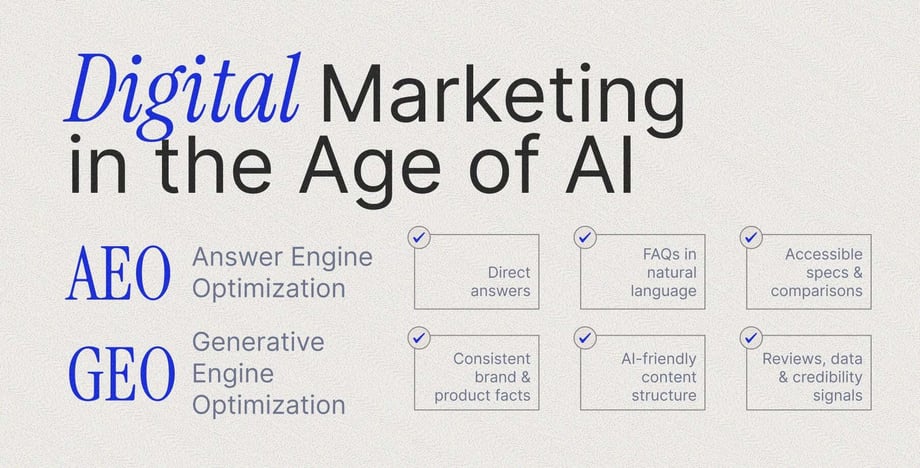
AEO (answer engine optimization) means structuring pages so an answer engine can cite them: a direct answer near the top, FAQs in the wording people actually use, specs that aren't buried in tabs, and comparisons that state a recommendation.
GEO (generative engine optimization) means making that same content easy for models to retrieve and summarize, through clear brand and product entities, facts that stay consistent across pages, and evidence like reviews and unique data a model can prefer over a thinner competitor page.
Both sit on top of SEO instead of replacing it. The extra work is extractability, and it's worth doing now, while plenty of competing catalogs are still built only to rank a list of links.
Search engine marketing (SEM / paid search)
Paid search buys the demand SEO hasn't captured yet, and branded search protects a name you've already paid to make known. Start with branded and high-intent non-brand terms, keep product feeds aligned with site price and availability, and review return on ad spend at campaign and product-group level. Pause what can't recoup fully loaded cost, and feed email and SMS engagement back into your audiences so bidding doesn't treat every click as a stranger.
Content marketing
Content earns the click now and the email open later. How-to articles, comparison pages, and "best for" roundups support a choice the buyer is already trying to make, which is why they beat posts written to fill a calendar. Map each piece to a job, then point it at the product pages it's meant to sell and reuse it in email and social. If you already publish regularly, a small set of strong comparison and category pages will outperform a large archive of thin ones.
Social media marketing
Buyers spend time on social, which isn't by itself an argument for being on every platform. Build for the two or three your buyers actually use, mix organic content for discovery with paid retargeting and catalog ads for conversion, and send that traffic to an offer-specific landing page instead of the homepage.
Influencer and affiliate marketing
A growing share of discovery happens through accounts that shoppers already follow, and these programs need the same tracking discipline as paid search. Mega-creators buy reach. Mid-tier and niche creators in your category often return more per dollar because the recommendation carries more weight, but only if you can see the codes and links.
Marketing automation and analytics
Marketing automation
Automation lets email, SMS, and ads run off the same triggers instead of nine separate calendars. The flows that pay back across most eCommerce categories are welcome, browse and cart abandonment, post-purchase, replenishment, and win-back. Behavioral triggers beat batch campaigns on all five, because the send matches something the shopper just did: a product viewed, a cart started, an inbox quiet for 60 days.
Cross-channel sequences need to run as one program. If email goes first, SMS follows only when the person hasn't converted and is opted in, and both stop the moment they buy. That's hard when each channel keeps its own list and straightforward when they share a contact record.
Analytics and measurement
If you review return on ad spend every week but rarely look at time-to-second-purchase or customer lifetime value, you're measuring acquisition far more carefully than retention. The fuller set worth tracking:
- Conversion rate
- Return on ad spend
- Customer lifetime value
- Repeat purchase rate
- Email and SMS revenue, including recovered carts
Open rates and session counts still help you locate a drop-off, but they won't explain why revenue moved.
Read channels together, and start with three dashboards
A prospecting campaign can look weak on last-click while feeding the email and SMS programs that close the order, and a high email click rate that never attaches to a purchase is a creative or offer problem more often than an audience one. If you can only staff a few dashboards, start with these three:
- Cost to acquire a first order
- Time and margin to a second
- Share of revenue from automated email and SMS
Setting up tools and platforms
Your stack has to connect store data, messaging, and reporting. When email, SMS, ads, and the catalog live in separate tools, every segment gets rebuilt by hand and nobody sees which path produced the order. A reasonable setup comes down to four things:
- One customer profile holding identity, consent, and purchase history.
- Email and SMS reading from that profile and sharing suppression.
- Catalog and inventory available to both the site and the campaigns.
- Reporting that attaches campaign exposure to orders, even when that attribution is modeled instead of exact.
The Maropost email and SMS marketing platform (Marketing Cloud) follows that pattern, running email, SMS, and automated programs from a shared contact record. It connects to Maropost Unified Commerce for customer, catalog, and order information.
What consolidation is actually worth
The payoff scales with how fragmented you were to begin with, and it usually shows up first as capacity: the same team can list and market far more product without more hours. Altapac went from 7,000 to 72,000 SKUs after moving product, marketing, and POS data onto one record, then reported 200% year-on-year growth in online orders across the four years that followed. Their general manager measured it in time rather than revenue: "Managing product data used to take days. Now it takes minutes."
An eCommerce marketing strategy you can pressure-test
An eCommerce marketing strategy answers three questions: who you're trying to reach, which owned and paid channels carry the message, and which conversion numbers decide where the next dollar goes. A digital marketing strategy for eCommerce that can't answer all three is a channel list with a budget attached.
Six checks to run against yours
- Shared customer data. POS, storefront, email, and SMS read the same identity, orders, and consent.
- Owned-channel core. Welcome, recovery, post-purchase, replenishment, and win-back run before you add acquisition spend.
- Search in both forms. SEO for classic results, AEO and GEO so AI tools can cite your product and comparison pages.
- Paid that respects known buyers. Prospecting for net-new, with suppression so you're not spending twice on people already in a recovery flow.
- Offers aligned with stock. Campaigns shouldn't sell what the warehouse can't ship.
- Measurement on LTV, not only first order. Keep the spend that creates a second purchase, even when the first-click report looks average.
Where most stacks leak
Most stores fail the paid check: respecting known buyers. Without a shared contact record, every channel keeps its own audience data and exclusions have to be rebuilt repeatedly. Connect email, SMS, and ads to the same customer record, and a segment created once works everywhere.
Change one thing at a time
Test where there's enough volume to read a result and hold the rest of the program steady. Do that, and CTA placement, offer framing, and landing-page order can each move revenue more than a new channel will.
Where to start
If you're running four or five channels and still can't say which one closed last week's orders, start there instead of adding a sixth. Get email and SMS onto one contact record, pick the single bottleneck you can staff this quarter, and agree upfront on the two numbers that will tell you whether it moved. The next channel can wait until those numbers say you need it.