

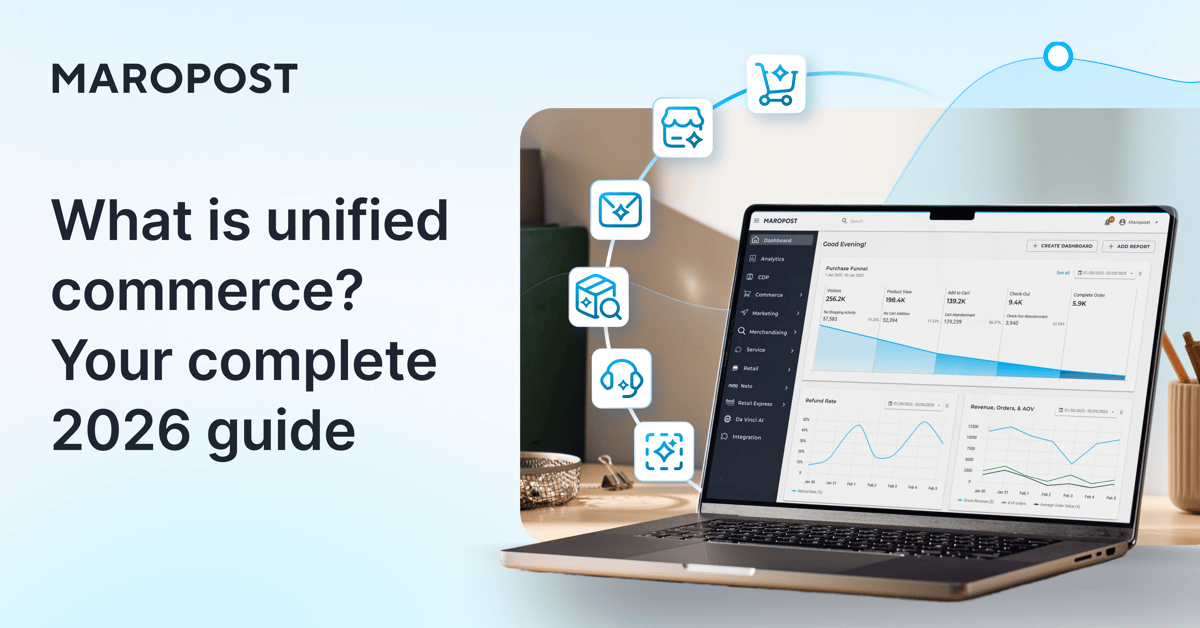
In 2026, consumers expect frictionless experiences everywhere they shop – whether it’s offline, online, in a mobile app, or on social channels. Yet, many retailers aren’t able to deliver it.
Disconnected systems create chaos: inventory data becomes mismatched across channels, sales slip through the cracks, and shoppers end up frustrated. Fortunately, unified commerce fixes that by making all the components of your commerce engine work together. And now is the right time to implement it.
The 6 pillars of unified commerce
What is unified commerce?
By definition, unified commerce is an architectural strategy that centralizes all sales channels (online, in-store, mobile, social media) and back-end systems (inventory, fulfillment, payments, marketing) into a single, native data core. It eliminates the need for fragmented third-party integrations by providing a single source of truth for the entire business.
Instead of relying on scattered systems that barely talk to each other and update only after the fact, unified commerce centralizes everything and keeps data synchronized in real time. A truly unified commerce platform provides “a single source of truth” for all operations (ecommerce, POS, inventory management, marketing, and support).
Maropost’s Unified Commerce platform is a strong example. Instead of integrating different point solutions, it connects all core commerce functions through a single, unified architecture built on a shared data foundation.
Omnichannel vs. unified commerce: the key differences
Omnichannel commerce connects customer-facing channels to deliver a seamless shopping experience, but back-end systems often remain fragmented. Unified commerce eliminates this by centralizing operations on a single platform.
| Focus Area | Omnichannel Commerce | Unified Commerce |
|---|---|---|
| Core Goal | Connecting channels for the customer | Unifying the entire business operation around the customer. |
| Technology Stack | Multiple, separate systems linked via APIs or middleware | A single, centralized platform that natively integrates front-end and back-end systems |
| Data Management | Data is often siloed by channel, requiring complex sync or aggregation | Single source of truth for all data, accessible in real-time across all touchpoints. |
| Customer Experience | Consistent, but slight friction or information gaps can occur | Truly seamless: customers can start and finish interactions across any channel without disruption |
| Cost Implications | Ongoing costs for maintaining multiple systems and their integrations | Lower Total Cost of Ownership (TCO) over time due to reduced integration and maintenance |
| Primary Benefit | Faster implementation, lower upfront costs | Unmatched operational efficiency and 360-degree customer view. |
| Main Challenge | Fragmented systems and inconsistent data | Requires migration from legacy systems |
Fragmented systems? Maropost eliminates the integration gap.
Book a DemoThe business case: why unified commerce is the standard for 2026
There are solid reasons why many ecommerce and retail merchants are making the switch to a unified commerce platform. The benefits are clear for both businesses and customers:
It lets you deliver better experiences that drive higher satisfaction and loyalty
When you run your business through a unified commerce platform, your customers get a more consistent, frictionless, and personalized experience no matter where and how they shop. And that fuels greater satisfaction and brand loyalty.
Based on the stats from the Adyen Agility Report Australia:
- 53% of consumers say they would be more loyal to a retailer that lets them buy things online and return them in-store.
- 39% would be more loyal to a retailer that enabled them to shop in-store and finish shopping online, or vice versa.
- 42% say they prefer retailers who remember their preferences and previous shopping behaviors to create a more tailored shopping experience.
It increases sales, improves operational efficiency, and reduces total cost of ownership (TCO)
According to research by Bain and Aptos:
- 99% of retailers believe a well-executed unified commerce strategy has an impact on overall profitability (73% cite a large to significant impact).
- 100% of retailers see an impact on overall sales revenue (with 76% citing a large to significant impact).
- Nearly 100% of retailers believe that an effective unified commerce strategy leads to higher average order values, lower operational expenses, and reduced lost sales.
Based on Shopify’s data, businesses using unified commerce platforms experience a 22% lower total cost of ownership (TCO) compared to multi-vendor stacks.
The 2025 Retail Capability Index report also revealed that retailers implementing unified commerce see 3x revenue growth,1.7x higher customer lifetime value, and 31% lower fulfilment costs.
2026 Retail ROI Calculator
Calculate your projected 2026 savings and revenue growth based on industry benchmarks (3x growth & 22% lower TCO).
*Projections based on 3x growth rate acceleration over market averages and 22% TCO reduction benchmarks.
Ready to unlock this growth? Book a Demo to see the platform.
Audit: is your business ready for unified commerce?
Here’s a readiness checklist to evaluate whether your current tech stack is holding you back:
If you answered “yes” to two or more of these questions, you're likely dealing with the hidden costs and inefficiencies of fragmented systems. A unified commerce platform can help eliminate these challenges – so this may be the right time to make the switch.
Book a Demo to Fix These IssuesUnified commerce in action: real-world use cases
What does it look like in practice? Imagine these real-world scenarios:
The unified commerce reality – and where Maropost fits in
Many brands assume that simply having a well-integrated commerce tech stack qualifies as unified commerce. But in reality, most are still operating with fragmented systems that don’t share real-time data. As a result, updates are delayed, information is inconsistent, and customer experience breaks at some point.
On top of that, when you rely on separate point solutions for core functions, you end up paying more for multiple tools, overlapping features, and ongoing integration maintenance. Omnichannel setups – even well-integrated ones – aren’t unified commerce in practice.
True unified commerce requires a single source of truth. That means a centralized data foundation where product, customer, and transactional data flow seamlessly and inform each other. It also means that adding new sales channels doesn’t require complex integrations or manual workarounds, but happens seamlessly on top of the same unified data layer.
Maropost was built to support unified commerce from the ground up and help mid-market merchants overcome the major challenges they face with fragmented tech stacks and traditional omnichannel setups. Maropost makes unified commerce a reality by offering a set of solutions that are built on a single data core and work in harmony within one solution. That includes:
- Ecommerce engine (Maropost Commerce Cloud)
- Point of Sale (POS) (Maropost Retail Cloud)
- Marketing automation (Maropost Marketing Cloud)
- Merchandising + recommendations (Maropost Merchandising Cloud)
- Customer support (Maropost Service Cloud)
Ready to switch from fragmented omnichannel to unified commerce? Explore the Maropost Unified Commerce platform.
Frequently asked questions
Is unified commerce only for enterprise businesses?
Not at all. Mid-market and growing merchants often benefit the most because they feel the pain of disjointed systems and data silos more acutely. With a unified commerce platform, they can scale in a cost-effective way without added complexity or integration burden.
When is the right time to upgrade from omnichannel to unified commerce?
Omnichannel may work well for your business if your channels share basic data, and your operations aren't too complex. But once you're managing multiple stores and regions and require real-time inventory accuracy and complex order fulfillment (like BOPIS or ship from store) – it's time to move to unified commerce.
What are the core technology components of a unified commerce platform?
A unified commerce platform is built on a single data core natively integrating key components, including ecommerce storefront, point of sale (POS), inventory and order management, marketing automation, unified customer profiles, and customer service. Maropost delivers all of this in one connected platform.
How does a unified commerce platform lower total cost of ownership (TCO)?
A unified commerce platform lowers the total cost of ownership by consolidating multiple software subscriptions into a single platform and reducing developer costs required to maintain third-party API integrations. It also minimizes manual data syncing and helps prevent costly inventory errors.
How does unified commerce enable hyper-personalization?
A unified commerce platform pools data from every touchpoint into a single customer profile. That gives businesses a 360-degree customer view and enables them to deliver tailored product recommendations, targeted marketing, and personalized messaging based on customer purchases, behaviors, and preferences.
How do I know if a platform is truly unified?
Many platforms that claim to offer "unified commerce" aren't really unified – they are often just well-integrated. With a truly unified commerce solution, you'll get real-time inventory updates across all your channels, the ability to manage all operations from one interface, and consistent customer profiles accessible to any employee.
Ready to future-proof your business?
See how Maropost brings your entire commerce ecosystem together in one platform.
Book a DemoSources
- Adyen Agility Report Australia 2025
- 2025 Retail Capability Index
- Bain & Aptos Global Retail Survey
- 2025 Industry TCO Benchmarks