
AI is no longer the future – it’s now, and it’s already reshaping every single industry. Ecommerce is obviously no exception. It’s no surprise that the AI ecommerce market is growing at lightning speed. In fact, according to data from SellersCommerce, the global AI-enabled ecommerce market is projected to grow from $8.65 billion in 2025 to $22.60 billion by 2032.
From better product discovery and personalized recommendations to smarter audience segmentation and conversational AI chatbots – AI helps ecommerce businesses improve customer experiences, drive higher conversions, and optimize operations.
In this blog, we’ll go over the top 3 most impactful AI applications in ecommerce. No theoretical use cases – just real-world examples of how ecommerce businesses like yours can use AI in their daily operations and see incredible results.
TL;DR
- AI in ecommerce refers to the usage of artificial intelligence in ecommerce operations to automate and optimize processes and drive more revenue.
- AI adoption remains limited in ecommerce, with 84% of businesses seeing AI as a competitive advantage, 48% experimenting with it, and only 29% fully implementing it.
- The top 3 revenue-driving AI use cases in ecommerce today include AI-powered site search, personalized product recommendations, and conversational AI chatbots.
- Maropost delivers a unified set of AI tools in one platform, helping ecommerce brands personalize at scale, optimize operations, and make smarter decisions.
What is AI in ecommerce?
AI in ecommerce refers to the use of artificial intelligence in ecommerce operations to automate processes, personalize customer experiences, improve conversions, and make more data-driven decisions. The core AI technologies working behind the scenes include natural language processing (NLP), generative AI, machine learning, predictive analytics, and more.
So, what does it look like in practice? For example, with AI-powered tools, ecommerce teams can:
- Build storefronts and landing pages in minutes
- Generate product descriptions, email copy, and images
- Optimize pricing dynamically to maximize margins
- Help shoppers find what they need faster through AI site search
- Provide personalized product recommendations
- Improve customer segmentation
- Automate pre- and post-purchase support
- Make more informed decisions based on AI analytics, and more.
But while most ecommerce businesses clearly see the value of AI, many haven’t fully adopted it yet. According to the State of Commerce report from Salesforce, 84% of commerce organizations believe AI gives them a competitive advantage, 48% are experimenting with AI, but only 29% have already fully implemented it.
That’s a big opportunity – companies that actually put AI into action now can pull ahead while others are still figuring things out.
Top 3 real-world use cases of AI in ecommerce that drive revenue
Let’s now take a closer look at how exactly ecommerce brands are using AI today to drive real, measurable results.
1. AI-powered site search and product discovery
When it comes to using AI in ecommerce, AI-powered site search is one of the most impactful AI applications. Unlike traditional site search, AI-powered site search uses AI to understand intent and context, not just exact keywords, to help shoppers find the right products with less effort.
It can handle typos, recognize synonyms, and understand conversational queries to showcase relevant search results. On top of that, AI-powered site search can analyze shopper behavior, learn from past interactions, and deliver even more personalized search results to every shopper.
Tangible benefits for ecommerce businesses:
- Reduce search abandonment: Based on data from Google Cloud, search abandonment costs retailers over $2 trillion annually, with 82% of US shoppers avoiding websites where they’ve experienced search difficulties in the past. AI-powered search reduces search abandonment and helps you recover lost sales.
- Improve customer experience: According to research from Nosto, 41% of shoppers get frustrated when they get irrelevant search results. AI-powered search improves search relevance and user experience by surfacing the right products in search results that align with real user intent.
- Increase customer retention: Along with customer experience, AI-powered search improves customer retention. Google Cloud’s data revealed that 99% of online shoppers are more likely to return to a website if it has a good search function.
- Generate more sales from existing traffic: Implementing AI-powered search enables you to drive more revenue from the traffic you already have. And even though just 16% of shoppers actually use the search function on ecommerce websites, they generate 55% of all online revenue, according to Salesforce research.
Recommended reading: AI-powered search in ecommerce: what you need to know in 2026
2. Personalized AI-driven product recommendations
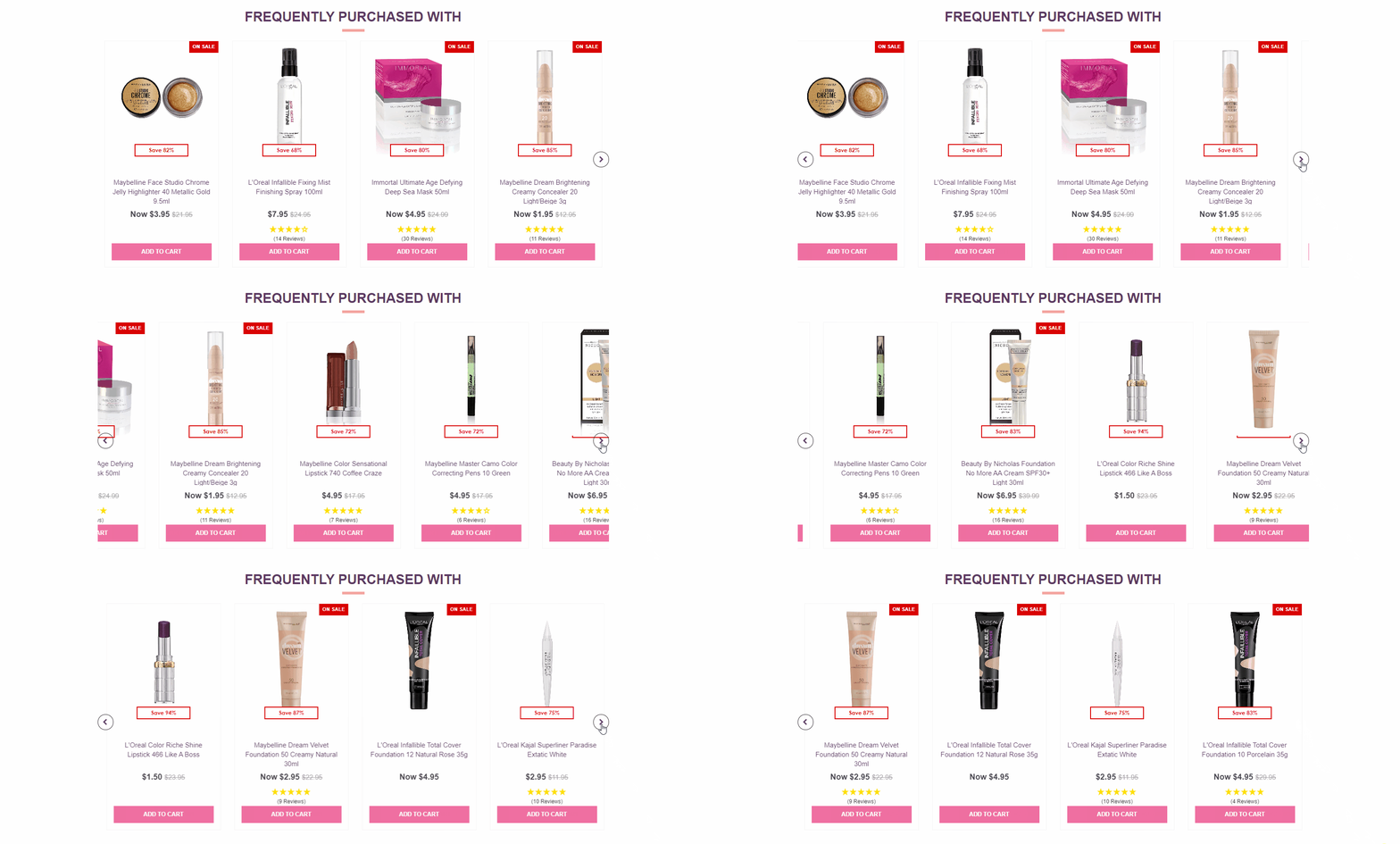
AI-powered product recommendations are product suggestions provided by AI and machine learning algorithms to encourage shoppers to discover products they are most likely to buy. The recommendation engine analyzes shopper browsing behavior, purchase history, and engagement patterns to recommend the most relevant products in real-time. AI product recommendations can be used as website widgets or product blocks inside marketing emails:
1. Product recommendation widgets on website pages
These are on-site widgets (carousels, grids, or lists) embedded directly into website pages that dynamically show products most relevant to each visitor. Those widgets may appear on different pages (homepage, category pages, checkout page, etc.). Common examples are:
- “Recommended for you”
- “Similar products”
- “Frequently bought together”
- “You might also like”
2. Product recommendation blocks in marketing emails
These are dynamic product blocks inside marketing emails, personalized for each recipient based on their purchase behavior, preferences, and predicted intent. They are typically used in promotional campaigns, post-purchase follow-ups, abandoned cart emails, and re-engagement campaigns.
Tangible benefits for ecommerce businesses:
- Reduce bounce rate: AI product recommendations can reduce bounce rates by immediately showing relevant products, guiding shoppers to their next action, and keeping them engaged longer.
- Improve user experience and retention: Today’s consumers expect personalization – and an AI product recommendation engine helps you deliver that. Based on a report from Twillio/ Segment, 62% of business leaders cite improved customer retention as a benefit of personalization efforts.
- Increase AOV through cross-selling/ upselling: AI product recommendations enable you to capitalize on cross-selling and upselling opportunities and ultimately increase average order values (AOV). According to Twillio’s report, 80% of business leaders say customers spend about 38% more when their experiences are personalized.
- Boost conversions and sales: When shoppers see products that match their needs and interests without having to look for them, they are more likely to buy. Amazon’s AI-driven recommendation system contributes to 35% of its overall revenue.
Recommended reading: AI product recommendations: the key to boosting your ecommerce sales
3. Conversational AI chatbots/ AI agents
Conversational AI chatbots (also referred to as AI agents) are becoming powerful revenue drivers for ecommerce businesses. Unlike basic rule-based chatbots of the past, AI chatbots use natural language processing, conversational AI, and machine learning to understand natural language and respond in a conversational way, just like a human support agent would. And for ecommerce businesses, in particular, AI chatbots have become much more than support automation tools.
Tangible benefits for ecommerce businesses:
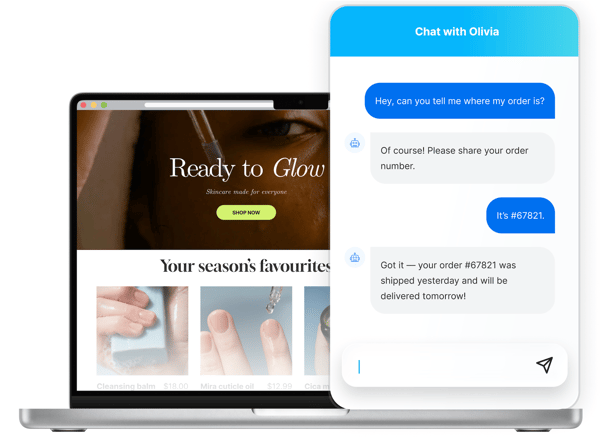
- Automate pre- and post-sale support: With an AI chatbot, you can easily automate pre- and post-sale support while also reducing the load on your support team, especially during peak periods. For example, AI chatbots can easily answer “Where is my order?” (WISMO) questions – and these requests account for up to 35% of customer support interactions in ecommerce.
- Increase customer satisfaction: Shoppers have come to expect immediate support and get frustrated when that doesn’t happen. An AI chatbot can deliver instant answers 24/7, including on weekends and holidays, helping you improve customer satisfaction. Based on SellersCommerce, 45% of US consumers value chatbots for providing immediate answers to their questions.
- Improve checkout conversion rate: Statistically, nearly 70% of carts are being abandoned. And according to multiple studies, implementing an AI chatbot can reduce cart abandonment by up to 30%. An AI chatbot can proactively offer assistance to shoppers, clarify shipping fees, help resolve payment issues, and improve your checkout conversion rate.
- Increase AOV through product recommendations: In addition to answering FAQs and resolving issues, some of the most advanced conversational AI chatbots for ecommerce can also provide relevant product recommendations to help you increase conversions and average order values.
Maropost’s offering: must-have AI features for ecommerce businesses in one platform
The effective use of AI in eCommerce can lead to better customer experiences, improved operational efficiency, and long-term profitability. The good news is that you don’t need a bunch of tools to take advantage of the use cases we’ve outlined above – Maropost offers it all and much more to help your ecommerce business get the most out of AI. Here’s what’s possible with Maropost:
- AI-powered site search: Maropost’s AI site search helps improve product discoverability and reduce search abandonment. With autocomplete prediction, spelling tolerance, and natural language processing, you can ensure shoppers always find what they want. On top of that, AI-driven personalized ranking learns from shopper behavior and surfaces high-conversion products at the top of search results.
- AI product recommendations: With AI-powered product recommendations, you can showcase relevant products on your website pages and emails, helping shoppers discover new products based on their interests, behavior, and past purchases – all while increasing conversions and average order values.
- AI-powered segment builder: With an AI-powered segment builder, you can easily create highly targeted audience segments to send more relevant email campaigns based on user behavior, preferences, and engagement patterns. You can choose from a variety of built-in segment prompts or simply describe your criteria in your own words, and the AI engine will create the segment in seconds.
- Conversational AI chatbot: With a conversational AI chatbot, you can support your customers 24/7 and help them get their questions answered immediately, without having to rely on your human support team. The chatbot can be trained to answer FAQs, provide relevant information, and resolve basic issues.
- AI-powered analytics: With built-in AI-powered reporting and analytics tools, you can turn complex data around all your ecommerce business operations into clear insights that drive smarter, faster, and more data-driven decisions.
Book a demo to see the Maropost Unified Commerce platform in action and learn how it can help your ecommerce business drive more revenue with intelligent, AI-powered automation.