

TL;DR
- Klaviyo’s 2025 pricing changes have pushed many ecommerce brands to reconsider its value and look for more affordable, flexible alternatives.
- Businesses consider Klaviyo alternatives due to rising profile-based costs, platform complexity, expensive add-ons, and limited customer support.
- Top 5 Klaviyo alternatives for ecommerce businesses include Maropost Marketing Cloud, Mailchimp, Campaign Monitor, Omnisend, and Brevo.
- Maropost Marketing Cloud offers volume-based pricing, better performance at high volumes, and 24/7 support, making it a stronger choice for fast-growing ecommerce brands.
For years, Klaviyo was the indisputable leader in ecommerce email marketing. And rightly so. But in 2025, things have changed dramatically. The February 2025 pricing updates and the “pay-for-every-profile” model – where you are now being charged for customers you don’t even email – have many brands looking for more affordable Klaviyo alternatives.
And frankly, for many, Klaviyo feels like owning a Ferrari just to drive to the grocery store. Though it still remains one of the most popular email marketing automation platforms for ecommerce businesses – the truth is, there are better alternatives out there, offering more value for money.
In this blog, we’ll review the top 5 Klaviyo alternatives you might want to consider in 2026, especially if you’ve been struggling to justify Klaviyo’s costs recently. Plus, we’ll explore how Maropost Marketing Cloud stacks up when compared to Klaviyo and why it’s a smarter choice for fast-growing ecommerce merchants.
NB: The information below is accurate as of January 2026.
Why should you consider a Klaviyo alternative?
So, first things first, what’s the problem with Klaviyo, and why would you want to consider an alternative solution? Let’s take a closer look at some of the major frustrations Klaviyo’s customers have been experiencing (based on user reviews from G2, Capterra, Trustpilot, and Reddit).
- Rising costs as you grow: To start off, Klaviyo recently shifted to charging customers based on the number of active profiles in their account – not just the contacts you email in a given month. In practice, that means Klaviyo’s costs can skyrocket quickly for fast-growing businesses.
- Complexity and steep learning curve: Next, setting up segments and advanced flows often requires understanding technical logic, which can be challenging for non-tech teams. Users often report needing to hire an agency or a dedicated specialist to manage the platform effectively.
- Expensive add-ons: In addition, while some providers offer features like RFM analytics and unified customer data as part of their core plans, Klaviyo offers them as a paid add-on. And adding these unbundled features can actually increase your monthly bill by hundreds of dollars.
- Limited customer support: To top it off, customer support is another pain point. Klaviyo’s users (especially those on lower-tier plans) frequently report slow response times via email and limited access to live chat support. Many users say they end up being pointed to generic help docs when what they need is real, situation-specific troubleshooting.
Top 5 Klaviyo alternatives for ecommerce businesses in 2026
Let’s now take a closer look at some of the best Klaviyo alternatives for ecommerce businesses, in particular, and how they compare to Klaviyo:
1. Maropost Marketing Cloud
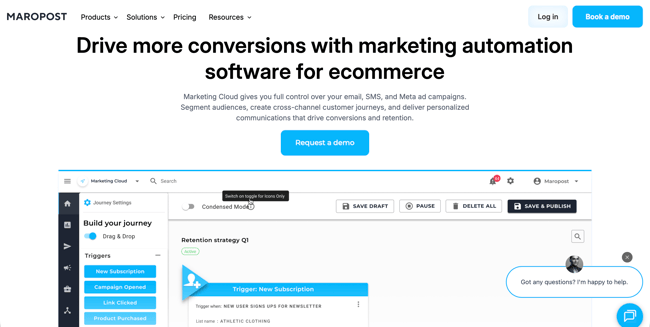
Maropost Marketing Cloud is a marketing automation platform built specifically for ecommerce businesses. While Klaviyo dominates the Shopify and DTC landscape, Maropost Marketing Cloud is the preferred choice for mid-market and enterprise ecommerce brands that require high-volume sending without the "success tax" of profile-based pricing.
Core features:
- Cross-channel campaigns (email+SMS+push notifications+Meta ads)
- Unlimited users, contacts, lists, and journeys with the Enterprise plan
- Dynamic landing pages + a drag-and-drop content builder
- Dynamic content and product recommendations
- Send-time and conversion-time optimization
- Advanced customer segmentation
- A/B testing campaigns
- Unified view of customer data across all channels
- eRFM analytics and custom reporting
- One-click third-party integrations
Key Maropost Marketing Cloud advantages over Klaviyo:
- Send-based pricing (vs Klaviyo’s active-profile-based pricing model)
- Scalability (Klaviyo’s performance can slow as contact volumes reach 500K–1M+)
- Native landing page builder and dynamic landing pages (not available in Klaviyo)
- 24/7 chat support across all plans (vs Klaviyo’s 24/7 chat support being limited to its highest tier)
Best for: Fast-growing mid-market to enterprise ecommerce brands that need scalable, multi-channel marketing with predictable pricing.
2. Mailchimp
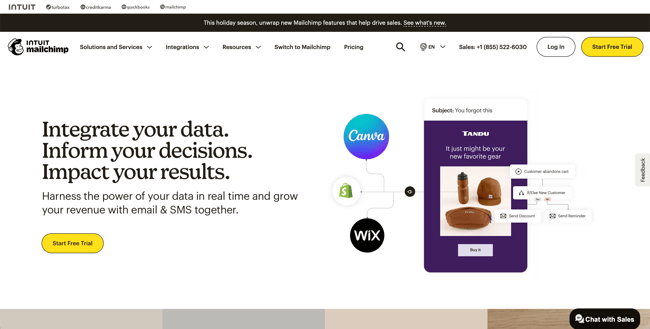
Mailchimp has evolved from a simple email service provider to an all-in-one marketing platform with AI and automation features that rival Klaviyo’s capabilities while maintaining better usability for less tech-savvy users. Compared to Klaviyo, Mailchimp prioritizes ease of use, a gentler learning curve, and broader marketing features, making it a better fit for small businesses.
Core features:
- Email and SMS campaigns
- Pre-built email templates
- Generative AI for creating and managing campaigns
- Send-time optimization
- A/B testing campaigns
- Forms and landing pages
- Dynamic content and product recommendations
- Advanced segmentation and behavioral targeting
- Custom reporting
- One-click integrations with third-party apps
Key Mailchimp advantages over Klaviyo:
- More beginner-friendly interface and simpler setup (vs Klaviyo’s steeper learning curve)
- A native, drag-and-drop website builder and landing page creator (not available in Klaviyo)
- Built-in social media management tools (vs Klaviyo’s strict focus on email and SMS)
- 24/7 live chat support on all paid plans (vs Klaviyo’s live chat support often being restricted to business hours)
Best for: Small ecommerce businesses that want an easy-to-use, all-in-one marketing automation platform.
Recommended reading: Top 5 Mailchimp alternatives to consider in 2026
3. Campaign Monitor
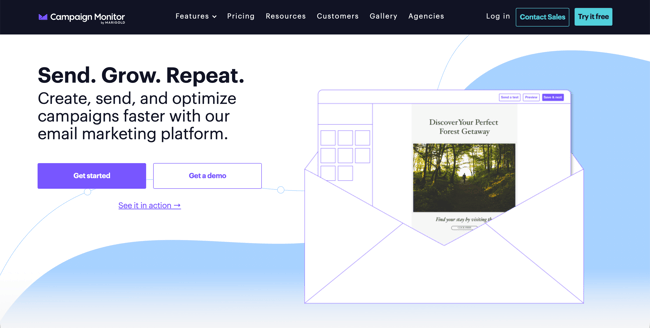
Campaign Monitor is a straightforward email marketing platform focused on ease of use and beautifully designed campaigns. It might be a better choice for small to mid-sized ecommerce businesses that want simplicity, branded email design, and consistent campaign sends and don’t need complex behavioral targeting or deep ecommerce analytics.
Core features:
- Drag-and-drop email builder and branded templates
- Pre-built automation journeys
- A/B testing campaigns
- Send-time optimization and time zone sending
- Deliverability support across all plans
- Dynamic content
- Advanced segmentation based on behavioral data
- AI segment builder
- Real-time reporting and analytics
- Third-party integrations and API access
Key Campaign Monitor advantages over Klaviyo:
- Ease of use (vs Klaviyo’s complexity and steeper learning curve)
- Strong focus on email design and visual templates (vs Klaviyo’s data-first email builder)
- Intuitive visual journey builder (vs Klaviyo’s more complex flow setup)
- More cost-effective pricing for small to mid-sized lists (vs Klaviyo’s active-profile-based pricing model)
Best for: Small to mid-sized businesses that need an intuitive platform to create visually stunning email campaigns without the technical complexity or data-heavy learning curve of a tool like Klaviyo.
4. Omnisend
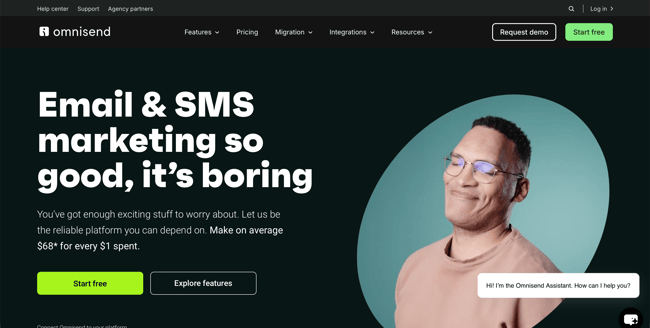
Omnisend is purpose-built for ecommerce businesses and integrates well with all major ecommerce platforms. It offers a similar set of features that rival Klaviyo’s ecommerce capabilities but with more affordable pricing. With fast setup and pre-built automation workflows, Omnisend works well for small to mid-sized ecommerce teams looking to launch campaigns quickly.
Core features:
- Cross-channel campaigns (email+SMS+push notifications)
- Pre-built email templates, workflows, and segments
- Pop-ups, sign-up forms, and landing pages
- List cleaning tool
- A/B testing and automation splits
- Product recommendations and dynamic content
- Generative AI for email content creation
- Sales and performance reports
- Pre-built integrations and API support
- 24/7 live chat and email support across all plans
Key Omnisend advantages over Klaviyo:
- Stronger out-of-the-box ecommerce workflows (vs Klaviyo’s more manual flow setup)
- Easier campaign setup for ecommerce teams (vs Klaviyo’s steeper learning curve)
- More generous free plan and lower entry-level pricing (vs Klaviyo’s more limited free tier)
- 24/7 email and live chat support across all tiers (vs Klaviyo’s limited support availability for lower-tier plans)
Best for: Small to mid-sized ecommerce brands that want an easy-to-use, budget-friendly email and SMS marketing platform with built-in automation and ecommerce-focused workflows.
5. Brevo
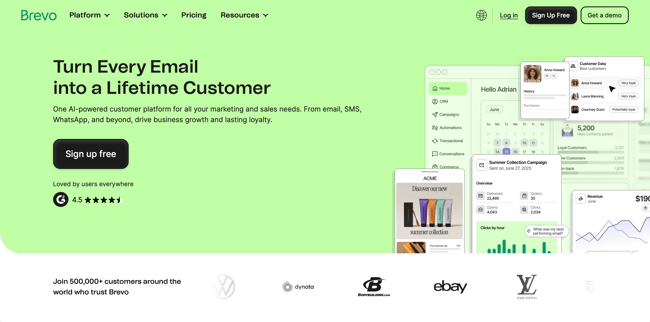
Brevo has proven to be a solid alternative to Klaviyo for ecommerce brands that want an all-in-one marketing automation platform. It integrates seamlessly with major ecommerce platforms, and compared to Klaviyo, it’s simpler and more cost-effective, making it a good fit for small to mid-sized ecommerce brands with straightforward marketing needs.
Core features:
- Email, SMS, and WhatsApp campaigns
- Drag-and-drop email editor + prebuilt templates
- Generative AI for email content creation
- AI send-time optimization
- A/B testing capabilities
- Landing pages
- Dynamic content and AI product recommendations
- Prebuilt and custom reporting and analytics
- Advanced segmentation
- Ecommerce integrations and APIs
Key Brevo advantages over Klaviyo:
- Volume-based pricing (vs Klaviyo’s active-profile-based pricing)
- Better SMS coverage with support for more countries
- More generous free plan with 300 sends/ day (vs Klaviyo’s 500 sends/month)
- Landing page builder, sales automation tools (not available in Klaviyo)
Best for: Small to mid-sized ecommerce businesses that want an affordable multi-channel marketing automation tool without the complexity and high cost of profile-based pricing.
Maropost Marketing Cloud vs Klaviyo: which one should you choose?
Klaviyo has strong brand recognition in email marketing, but that doesn’t mean it’s the ideal solution for every ecommerce business. Here’s a detailed comparison with Maropost Marketing Cloud to help you evaluate which platform better meets your needs.
Maropost Marketing Cloud vs. Klaviyo at a glance
|
Maropost Marketing Cloud |
Klaviyo
|
|
| Email campaigns | ✔ | ✔ |
| SMS campaigns | ✔ | ✔ |
| A/B testing | ✔ | ✔ |
| Transactional emails | ✔ | ✔ |
| Send-time optimization | ✔ | ✔ |
| Conversion-time optimization | ✔ | ✘ |
| Deliverability rate | 98% | 98% |
| Deliverability support team | ✔ | ✔ |
| Custom email domain | Unlimited | 1 per account |
| Custom SMS link tracking domain | Unlimited | 1 per account |
| Visual journey builder | ✔ | ✔ |
| Unlimited journeys (flows) | ✔ | ✔ |
| Landing page builder | ✔ | ✘ |
| Dynamic landing pages | ✔ | ✘ |
| Dynamic content | ✔ | ✔ |
| Product recommendations | ✔ | ✔ |
| Unlimited contact lists | ✔ | Up to 1,000 lists in a single account |
| Advanced segmentation | ✔ | ✔ |
| AI segment builder | ✔ | ✔ |
| Unified customer data | ✔ | Additional cost |
| eRFM analytics | ✔ | Additional cost |
| Custom reports | ✔ | ✔ |
| One-click integrations | ✔ | ✔ |
| Facebook Custom Audience integration | Real-time | 1-to-2-day delay |
| 24/7 chat support | Across all plans | Only with the highest-tier plan |
| Dedicated customer success manager | ✔ | ✔ |
| Dedicated onboarding | ✔ | ✔ |
✔️ Maropost Marketing Cloud vs. Klaviyo: pricing structure
Klaviyo now automatically bills based on active profiles. And as your contact list grows, your monthly bill can skyrocket because if your active profiles exceed your current plan threshold, Klaviyo will automatically move you into the next pricing tier. As a result, existing customers report facing significant monthly cost increases (often jumping to 20-30%). Maropost Marketing Cloud charges based on emails sent, not the number of contacts you store, helping you avoid unnecessary costs.
✔️ Maropost Marketing Cloud vs. Klaviyo: advanced features
Though Klaviyo offers a comprehensive set of features, it still lacks some capabilities that similar email marketing platforms provide. In addition, advanced features like RFM reporting and unified customer data require extra payment, which can add up to your overall monthly costs. With Maropost Marketing Cloud, these features are available for users across all plans at no additional cost.
✔️ Maropost Marketing Cloud vs. Klaviyo: scalability
Technically, Klaviyo supports large lists, but many users experience slower performance as you approach high contact counts (e.g., 500K–1M+), which means it’s best suited for small to mid-sized businesses. Maropost is purpose-built for scalability – supporting fast-growing ecommerce brands and enabling millions of emails to be sent without any performance issues.
✔️ Maropost Marketing Cloud vs. Klaviyo: customer support
While Klaviyo does offer a strong library of self-serve resources, its customer support often faces criticism for limited availability and responsiveness. Klaviyo lacks phone support, and live chat support isn’t available 24/7 unless you are on the highest-tier plan. G2 and Trustpilot’s users also report slow response times and delayed issue resolution. Maropost’s support is available 24/7 across multiple channels, which might be a real advantage when you need immediate help.
✔️ Maropost Marketing Cloud vs. Klaviyo: capabilities beyond marketing automation
Klaviyo is just an email and SMS marketing automation tool, while Maropost Marketing Cloud is part of Maropost’s broader unified commerce platform. If you want a single solution to run your entire ecommerce business – from storefront and inventory management to order fulfilment, merchandising, marketing, and customer support – Maropost is the right choice.
Maropost Marketing Cloud vs. Klaviyo: the final verdict
Klaviyo works well for small to mid-sized ecommerce-focused businesses, but at very large contact volumes, costs can rise sharply, and performance may suffer. Maropost Marketing Cloud, which is built to handle large-volume sends, making it a logical next step for mid-sized to enterprise ecommerce brands that have outgrown Klaviyo’s limitations.
Book a demo now to see Maropost Marketing Cloud in action and understand whether it aligns with your email marketing automation needs.
Frequently asked questions
Why is Klaviyo so popular?
Klaviyo is popular because it’s deeply integrated with leading ecommerce platforms like Shopify and BigCommerce and comes with prebuilt automation flows, data-driven segmentation, dynamic content blocks, revenue attribution, predictive analytics, and a large library of educational resources. Additionally, Klaviyo offers a free plan with a rich set of features, making it an attractive solution for small teams.
What are the weaknesses of Klaviyo?
Klaviyo’s primary weakness is its contact-based pricing model, which charges for every active profile in your account – even those you don’t email – making it costly to scale as your contact list grows. Plus, users frequently report a steep learning curve for advanced segmentation and automation workflows, a lack of native landing pages, additional charges for marketing analytics and unified customer data, and limited customer support for lower-tier plans.
What’s the best Klaviyo alternative for ecommerce businesses?
The best Klaviyo alternative for ecommerce businesses is Maropost Marketing Cloud, especially for brands that want a unified platform beyond email and SMS automation. Maropost offers truly omnichannel marketing automation, advanced segmentation, unified customer data, and predictable pricing not tied to contact volume. On top of that, Maropost Marketing Cloud supports large email sends without the performance drop that many fast-growing ecommerce businesses experience with Klaviyo.