To increase email open rates in 2026, focus on subject lines and preheaders, list segmentation, deliverability (SPF/DKIM/DMARC), send-time testing, mobile-friendly design, and A/B tests. For ecommerce, benchmark open rates are roughly 30–38% — use the 11 tactics below to beat your baseline.
TL;DR
- An email marketing open rate is the percentage of delivered emails that recipients open, influenced by factors like subject lines, timing, and sender reputation.
- You can increase email open rates by refining subject lines and preheaders, avoiding spam triggers, segmenting audiences, personalizing content, optimizing sender names and send times, ensuring mobile friendliness and deliverability, A/B testing campaigns, and resending unopened emails strategically.
- Maropost Marketing Cloud (Maropost's platform for email, SMS, and marketing automation) helps you run efficient email campaigns and boost open rates with AI segmentation, ~98% deliverability (stated by Maropost), personalized automation, and eRFM reporting.
Email marketing remains one of the highest-ROI channels for ecommerce. Based on the State of Email report from Litmus, for every $1 spent on email marketing, 35% of companies earn $10–$36 — often outperforming paid social.
But strong creative still fails if open rates are low. Below: benchmarks, 11 proven tactics, and how to track results alongside other email marketing metrics and KPIs.
Choosing or switching ESP? Our best email marketing platforms for ecommerce guide compares deliverability, segmentation, and pricing.
On this page:
- What is an email open rate?
- Average email open rate (2026 benchmarks)
- 11 tips to increase open rates
- 1. Subject lines · 2. Preheaders · 3. Spam triggers · 4. Segmentation
- 5. Sender name · 6. Personalization · 7. Send times · 8. Mobile
- 9. Deliverability · 10. A/B testing · 11. Resend unopened
- Maropost Marketing Cloud
- FAQ
What is an email marketing open rate?
An email open rate is the percentage of recipients who opened an email out of the total successfully delivered. Influencers include subject lines, timing, sender reputation, and segmentation.
Email open rate = (# of email opens ÷ # of emails delivered) × 100%
Open rate is useful but never the only metric — pair it with click-through rate, conversion rate, and deliverability. See our full guide to email marketing metrics and KPIs.
What is the average email open rate?
According to GetResponse's Email Marketing Benchmarks report (4.4 billion messages analyzed), the average global email open rate is 39.64%. Rates vary by industry, region, and send type — Europe often averages ~43%, North America ~24%.
Average email open rate for ecommerce:
Use these as directional benchmarks — compare against your own historical performance first.
11 tips to increase your ecommerce email marketing open rates in 2026
Apply these tactics in order of impact for your list: deliverability and subject lines usually move the needle fastest.
1. Sharpen your email subject lines
Your subject line is the gateway to your content. 47% of recipients decide whether to open based on the subject line alone; 69% may mark mail as spam if it looks suspicious.
Three rules for ecommerce subject lines:
- Keep it short (under 70 characters) — GetResponse found 61–70 character subjects averaged 32.1% opens across 7B emails.
- Personalize beyond first name — reference recent browsing, cart items, or category interest.
- Limit punctuation and emojis — Mailchimp suggests max 3 punctuation marks and one emoji per subject.
2. Make your preheader work for you
Preheader (preview) text supports your subject line — typically 80–100 characters. GetResponse data shows emails with a preheader average 44.67% open rate, several points above baseline.
If you skip the preheader, most ESPs show the first body line instead — often wasted inbox space.
3. Cut out words that trigger spam filters
According to CloudHQ, 48% of emails land in spam. Avoid exaggerated claims, fake urgency, and overly promotional phrasing in subject and body:
- Exaggerated claims: "100% satisfied", "lowest price", "free gift", "incredible deal"
- False urgency: "act now", "do it today", "take action"
- Shady-sounding offers: "no catch", "no questions asked", "cancel at any time"
- Overused promo jargon: "clearance", "discount", "pre-approved", "unlimited"
4. Segment your audience
Segmented campaigns drive 30% more opens and 50% more click-throughs than batch sends (Sender). Strong ecommerce segments:
- Purchase history and category interest
- Customer lifecycle (new, active, lapsed)
- Engagement level (opens/clicks in last 30/90 days)
- Cart abandoners and VIP / high-LTV buyers
- Location and time zone
5. Choose the right sender name
42% of people check the sender name before opening. Two patterns that work:
- [First name] from [Brand] — personal, good for tips and support content
- [Brand] Team — clear for promotions and product launches
6. Personalize your content
Personalized subject lines can lift opens by up to 26% (Campaign Monitor). Example: "Hi Peter, we added the features you requested" beats "Dear subscriber, new features inside".
7. Optimize your send times
No universal best time — test for your audience. GetResponse benchmarks show stronger opens in early morning (4–6 AM) and late afternoon (5–7 PM) slots; Tuesdays slightly lead other weekdays but differences are modest.
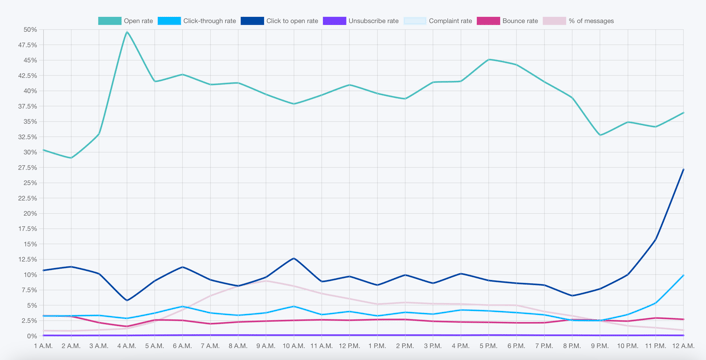
Image source: GetResponse
8. Make sure your emails are mobile-friendly
Mobile accounted for 55%+ of global email opens in 2025 (Genesys); 75% delete non-mobile-friendly mail immediately. Keep mobile subject lines to 25–50 characters and use large tap targets and readable fonts in the body.
9. Stay out of the spam folder
Opens can't happen if mail never reaches the inbox. Since Gmail and Yahoo tightened authentication in 2024, follow deliverability fundamentals:
- Permission-based lists only
- Clear opt-in expectations (frequency and content type)
- SPF, DKIM, and DMARC on your sending domain
- Visible unsubscribe — hidden opt-out drives spam complaints
- Consistent send volume — avoid sudden spikes
- List hygiene — remove bounces and long-term inactive contacts
For a full walkthrough, read email deliverability 101: how to reach the inbox in 2026.
10. A/B test your email campaigns
Test one variable at a time: subject line, preheader, sender name, or send time. Changing multiple elements at once makes results impossible to interpret.
11. Resend unopened emails
A follow-up send with a new subject line or timing can add ~30% more opens (MailerLite). Remove chronic non-openers after several attempts to protect sender reputation.
How Maropost Marketing Cloud can help you run efficient email campaigns
Higher open rates need both tactics and tooling. Our email marketing platform comparison helps you shortlist ESPs with strong deliverability and segmentation.
Maropost Marketing Cloud is Maropost's platform for email marketing, SMS, automated journeys, and Meta ad campaigns — not a generic third-party "marketing cloud." It helps ecommerce teams:
- Build AI-powered segments so each send reaches the right audience
- Improve inbox placement with ~98% stated deliverability, Deliverability Score, and Spam Checker tools
- Personalize at scale with dynamic content and product recommendations
- Plan with eRFM reporting — recency, frequency, monetary value, and engagement in one view
Book a demo or see Maropost pricing.
Related reading
- 5 Best Email Marketing Platforms for Ecommerce (2026)
- 10 essential email marketing metrics and KPIs
- Email deliverability 101
- Mailchimp alternatives for ecommerce
- Marketing automation strategy: 6 steps
- Maropost Marketing Cloud
Frequently asked questions
What is a good email open rate?
A good email open rate is typically 35–40% globally, but ecommerce often lands closer to 30–38%. Benchmark against your own history and improve subject lines, segmentation, and deliverability rather than chasing a single industry number.
What is the average email open rate for ecommerce?
Recent vendor benchmarks put ecommerce open rates around 29.81% (Mailchimp) and 37.93% (Klaviyo). Your rate depends on list quality, send frequency, and whether promotional vs transactional mail dominates.
What other email marketing metrics should I track?
Beyond opens, track delivery rate, click-through rate, conversion rate, unsubscribe rate, bounce rate, and spam complaint rate. Our essential email marketing metrics and KPIs guide explains each one.
How can I improve my subject lines to boost open rates?
Lead with clear value, curiosity, or urgency — without spam triggers. Personalize using behavior (cart items, categories browsed), keep mobile subjects under 50 characters, and A/B test variations weekly on your highest-volume sends.