

Key Takeaways:
-
In 2026, choosing an email marketing platform is far more complex, with success depending on reliable inbox placement and meaningful, behavior-based personalization.
-
When selecting an email marketing platform, prioritize granular segmentation, strong deliverability, AI and automation tools, advanced personalization, robust analytics, enterprise-grade scalability, and predictable pricing that supports long-term growth.
-
Top email marketing platforms for ecommerce in 2026 include Maropost Marketing Cloud for fast-growing teams, Klaviyo and Omnisend for mid-sized businesses, Mailchimp for SMBs, and Brevo for enterprise teams.
-
Maropost Marketing Cloud stands out as the best email marketing software for ecommerce businesses thanks to advanced eRFM segmentation, high deliverability, AI-powered personalization, enterprise scalability, and unified commerce capabilities.
Back in the day, picking an email marketing platform was fairly easy. You basically needed a platform that could… well, send emails without breaking – and maybe drop a first name into the subject line to make your messages feel “personalized.”
In 2026, things are a lot more complicated. You need to make sure your emails land in inboxes – not spam folders – and email personalization now goes far beyond just a name in the subject line. Because even though 69% of consumers worldwide say email is their preferred way to hear from brands, they expect messages that reflect their behavior, preferences, and timing.
In this blog, we’ve outlined the five best email marketing platforms for ecommerce businesses worth your attention in 2026. On top of that, we break down the key features and capabilities that make the difference between average email marketing tools and platforms built for real automation, personalization, efficiency, and scale. Let’s get straight to it!
What to look for when choosing an email marketing platform for ecommerce businesses
There are dozens (if not hundreds) of email marketing automation platforms out there, all claiming to be the perfect solution. So, how do you choose the right one without getting lost in feature lists and bold promises that all start to sound the same?
While there isn’t a single “ideal” solution for everyone, there are a few non-negotiables, especially if you’re looking for a reliable platform that can scale with your business, consistently land your emails in inboxes, and support meaningful ecommerce personalization:
Granular segmentation:
Customer segmentation might be a deal-breaker for ecommerce businesses with diverse product catalogs or those selling internationally. The ability to segment audiences based on purchase history, location, and real-time behavior allows you to send messages that actually make sense for each customer. The best email marketing automation platforms enable granular audience segmentation so you can target customers with precision at every stage of their journey.
Strong deliverability:
Email deliverability can easily make or break the success of your email marketing strategy. Because what’s the point of running email campaigns if your messages land in spam folders and disappear into the void, never reaching your recipients? While 100% is unrealistic, a good email deliverability rate typically ranges from 92% to 95%. Look for a platform with the tools and infrastructure needed to consistently hit that deliverability range and keep your emails landing in inboxes.
AI and automation:
AI and automation capabilities can help speed up and simplify pretty much everything – from audience segmentation and journey building to email content creation and performance analysis. More importantly, they enable you to scale personalization without adding complexity. But while many platforms claim to be “AI-powered,” not all of them offer meaningful AI features. When evaluating platforms, look for AI capabilities that deliver real, measurable value.
Email personalization tools:
Research shows that personalized emails drive 52% more sales than generic, one-size-fits-all messages. If you want to deliver truly personalized experiences, you need a platform that lets you personalize both email content and timing, not just subject lines. Some key features to enable better email personalization are dynamic content within emails, relevant product recommendations based on shopper behavior, and send-time optimization.
Reporting and analytics:
A good email marketing platform should come with robust reporting and analytics tools that let you track the email marketing metrics and KPIs that matter to your business. But beyond the ability to track basic campaign-level metrics, look for platforms with advanced eRFM analytics that provide deeper insight into customer purchase behavior, overall engagement, and lifetime value.
Reliability and scalability:
What happens when your email list grows, and you’re suddenly sending hundreds of thousands of emails? You need a reliable email marketing automation platform built for enterprise-grade scalability. Some tools work well for small to mid-sized businesses, but fast-growing brands need a platform that can handle massive contact databases and high-volume sending without sacrificing performance.
Predictable pricing:
Cost is always an important factor when choosing an email marketing automation platform, especially for smaller businesses. With many platforms, SMBs often end up paying for features they don’t actually need. On top of that, costs can rise quickly as your contact list grows, since many providers charge per contact, including duplicates across multiple lists and even inactive contacts. Look for a provider with predictable pricing that aligns with your business size and growth needs.
A closer look at the top 5 best email marketing platforms for ecommerce in 2026
1. Maropost Marketing Cloud
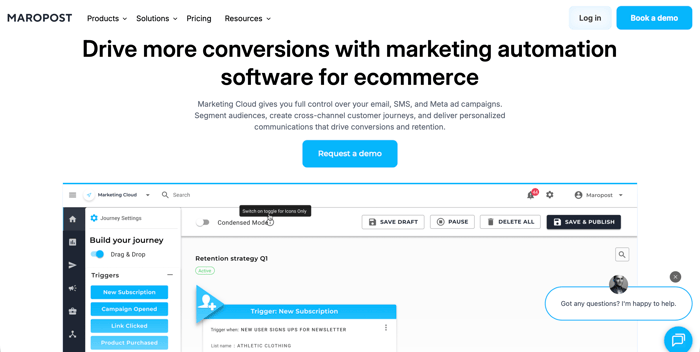
Maropost Marketing Cloud is an email automation software built specifically for fast-growing ecommerce brands with high-volume sending needs. Unlike some other popular platforms that bill based on active profiles, Maropost charges based on emails you send, not the number of contacts you store, helping you avoid cost spikes as your list grows. With Maropost Marketing Cloud, you can orchestrate cross-channel campaigns and segment customers using advanced eRFM reporting to deliver more personalized, retention-focused campaigns.
Core features:
-
Cross-channel campaigns (email+SMS+Meta ads)
-
Transactional emails
-
Visual customer journey builder
-
AI-powered segment builder
-
Advanced segmentation with eRFM reporting
-
Dynamic landing pages
-
Dynamic content and AI product recommendations
-
Send-time/ conversion-time optimization
-
A/B testing campaigns
-
Deliverability support and remediation
-
One-click third-party integrations
-
Unified customer profiles
| Pros | Cons |
|
|
Best for: Fast-growing ecommerce businesses (mid-market + enterprise) with high-volume sending needs.
2. Klaviyo
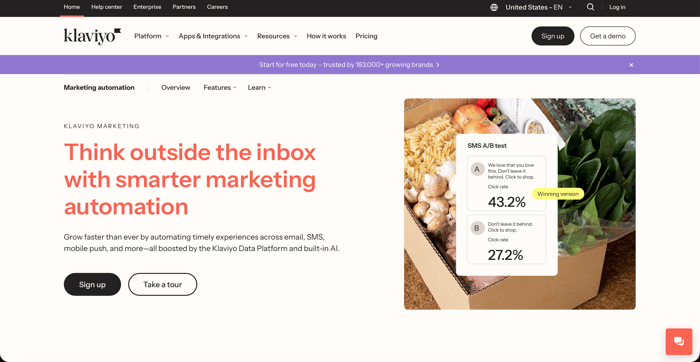
Klaviyo is a popular email marketing platform designed for ecommerce businesses. It is known for deep integrations with major ecommerce platforms (like Shopify, BigCommerce, WooCommerce, Magento) and advanced eRFM and predictive analytics, enabling you to send highly targeted email campaigns aligned with shoppers’ purchase behavior and engagement. On the flipside, however, Klaviyo’s pricing model is based on active profiles, so your monthly bill can quickly skyrocket as your contact list grows.
Core features:
-
Email and SMS campaigns
-
Generative AI for content creation
-
Visual journey builder
-
AI segment builder
-
Dynamic content and product recommendations
-
A/B testing campaigns
-
Deliverability support
-
eRFM analytics + predictive insights (added cost)
-
Product reviews (added cost)
-
Strong integrations with ecommerce platforms
| Pros | Cons |
|
|
Best for: Small to mid-sized ecommerce businesses that need advanced customer segmentation and deep personalization.
Recommended reading: Top 5 Klaviyo alternatives for ecommerce businesses in 2026
3. Mailchimp
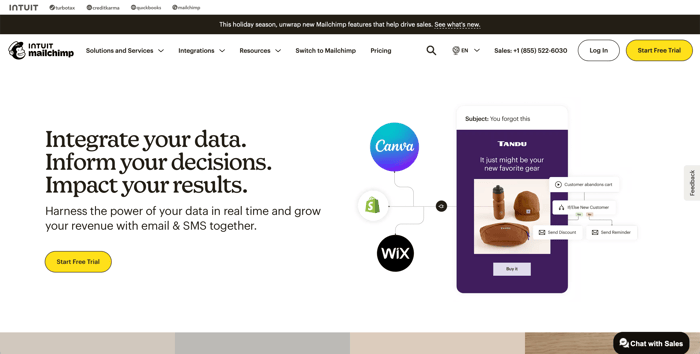
Mailchimp is one of the most widely recognized email marketing platforms in the space. Many ecommerce brands choose it as their first email marketing tool simply because of its strong name recognition – and because it’s fairly easy to use and gets you started quickly. In addition, it also offers SMS and social media management tools beyond email marketing. But you may hit the ceiling fast. Similar to Klaviyo, Mailchimp charges you for every contact, so pricing can escalate quickly as your list grows.
Core features:
-
Email and SMS campaigns
-
Generative AI for campaign creation
-
Pre-built and custom-coded templates
-
Forms and landing pages
-
Dynamic content and product recommendations
-
A/B testing campaigns
-
Send-time optimization
-
Advanced segmentation
-
Custom reporting
-
One-click integrations with third-party tools
| Pros | Cons |
|
|
Best for: Small ecommerce businesses with straightforward email marketing needs.
Recommended reading: Top 5 Mailchimp alternatives to consider in 2026
4. Omnisend
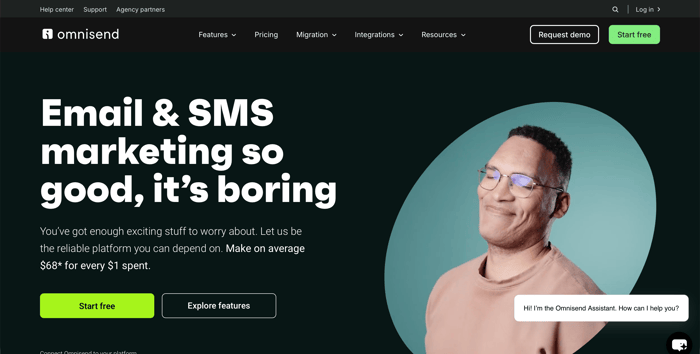
Omnisend’s email and SMS marketing platform is purpose-built for ecommerce businesses and seamlessly integrates with major ecommerce platforms like Shopify, BigCommerce, and WooCommerce. It’s a great option for small and mid-sized teams looking to launch campaigns quickly, as it offers a large library of ready-made email templates, gen AI tools for email content creation, and pre-built ecommerce-specific automation workflows.
Core features:
-
Cross-channel campaigns (email+SMS+push notifications)
-
Generative AI for email content creation
-
Dynamic content blocks
-
Personalized product recommendations
-
Pre-built ecommerce workflows and templates
-
Sign-up forms and landing pages
-
A/B testing campaigns
-
Advanced segmentation
-
Sales and performance reports
-
Third-party integrations and APIs
| Pros | Cons |
|
|
Best for: Small to mid-sized ecommerce businesses that need an easy-to-use email and SMS marketing platform with ready-made ecommerce workflows.
5. Braze
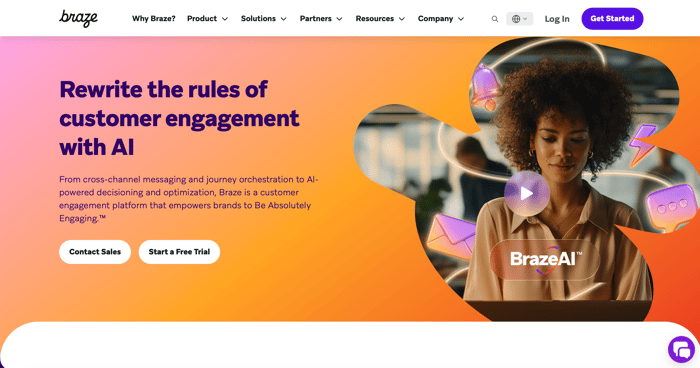
Braze positions itself as a customer engagement platform rather than just an email marketing software. It enables you to run cross-channel campaigns across email, SMS, web, mobile app, WhatsApp, and digital ads. Braze is suitable for larger teams with in-house developer resources because setting up the platform, complex campaigns, and automations can be complicated. It’s also more expensive compared to many alternatives (expect $60K+/year).
Core features:
-
Cross-channel campaigns (email, web, mobile push, SMS, WhatsApp)
-
Visual journey builder (drag-and-drop editor)
-
Pre-built email templates
-
Generative AI for content creation
-
Dynamic content and product recommendation
-
AI agents for workflow automation
-
A/B testing tools
-
Flexible segmentation
-
Advanced analytics and reporting
-
Third-party integrations and APIs
| Pros | Cons |
|
|
Best for: Enterprise ecommerce businesses with multi-channel messaging needs.
What makes Maropost Marketing Cloud the best email marketing platform for ecommerce businesses
As you’ve seen above, what makes the best email automation platform for ecommerce brands depends heavily on your business needs, company size, and how fast you’re growing. And here’s why Maropost Marketing Cloud could be the best choice for your ecommerce business:
-
Advanced segmentation with eRFM reporting: With eRFM reporting, you can segment customers more effectively by combining purchase behavior with engagement signals, helping you send more relevant, personalized, and timely campaigns that lead to higher engagement and conversions.
-
98% deliverability rate: While many email marketing platforms fall short on deliverability, Maropost Marketing Cloud maintains a 98% deliverability rate through adaptive delivery, a strong sender reputation, real-time reporting, and dedicated deliverability support and remediation.
-
AI-powered personalization: With dynamic content blocks and relevant product recommendations based on each shopper’s interests and purchase behavior, you can create more personalized email campaigns that generate more clicks and conversions.
-
Send-time and conversion-time optimization: Send-time optimization ensures emails reach each contact at the moment they’re most likely to open, based on past engagement. And conversion-time optimization takes it a step further by sending promotional messages when each contact is most likely to convert.
-
Enterprise-level scalability: While many platforms are built for small businesses, Maropost Marketing Cloud is designed for growth and scalability. It easily handles massive contact databases (500K–1M+ profiles) and high-volume sending without any performance issues.
-
Unified commerce (beyond email marketing): Marketing Cloud is more than an email marketing tool. It’s part of Maropost’s unified commerce platform that lets you run your entire ecommerce business with a single solution – including storefront, order management, marketing automation, merchandising, and support – without relying on third-party integrations.
Book a demo now to see Maropost Marketing Cloud in action and learn how it can support your email marketing automation needs.
Frequently asked questions
What is an email marketing platform?
An email marketing platform (or an email marketing automation platform) is a software solution that helps businesses create, send, automate, and track email marketing campaigns. These platforms usually include features for email creation, audience segmentation, personalization, workflow automation, A/B testing, email campaign performance tracking, and more. Email marketing platforms enable businesses to send highly personalized emails to drive engagement, conversions, and retention.
Is email marketing still worth it?
Absolutely yes. In 2026, email remains one of the highest-ROI marketing channels. When done right, email marketing can deliver up to $45 in ROI for every $1 invested, consistently outperforming paid search and social media. With over 4.7 billion global email users, it remains the most reliable way for businesses to reach and engage with their audience. And according to data from Salesforce, for 68% of consumers, email remains their primary communication channel with brands.
Which platform is best for email marketing?
That heavily depends on your business goals, size, industry, and growth pace. Maropost Marketing Cloud is a strong choice for fast-growing ecommerce brands that need enterprise-level scalability and industry-leading deliverability. Klaviyo and Omnisend are popular with mid-sized ecommerce businesses focused on deep segmentation and revenue-driven automation. Mailchimp often appeals to SMBs with basic email marketing needs, while Braze might be a smart choice for large-scale businesses that need cross-channel campaign orchestration.
How to choose an email marketing platform?
Start by defining your budget and the essential features you need, such as advanced segmentation, automation, email personalization tools, reporting and analytics, etc. Prioritize platforms with high deliverability rates to ensure your messages land in inboxes rather than spam folders. And if budget is a concern, look for platforms with a pricing model that remains predictable as your list grows. Plus, the platform should seamlessly integrate with your existing tech stack.