
In 2026, online consumers demand seamless experiences, hyper-personalization across the entire journey, flexible shopping options, and instant support, to name just a few expectations. If your brand isn’t delivering on these, you’re likely losing a significant share of your revenue to brands that are.
To stay competitive in 2026, you don’t just need high-quality products. You need to understand and consistently match your shoppers’ expectations because they are rapidly changing, while the competition remains incredibly high.
So what does this mean in practice? In this blog, we’ve outlined the top 10 research-backed consumer expectations ecommerce brands need to be aware of. These insights will help you identify where your brand stands today and what you need to prioritize to win in 2026.
TL;DR
- In 2026, customer expectations in ecommerce are higher than ever, with shoppers demanding seamless experiences, hyper-personalization, and flexible shopping options across channels and devices.
- To stay competitive, ecommerce brands must use AI to personalize experiences, improve product discovery, prioritize mobile and social commerce, offer flexible payments, use AR for product visualization, and deliver 24/7 support.
- Maropost’s unified commerce platform helps ecommerce brands meet customer expectations with AI-powered personalization, smarter product discovery, flexible payments, and AI support in one solution.
Top 10 customer expectations ecommerce brands need to meet in 2026 and beyond
Here’s what online shoppers increasingly expect from brands in 2026 in terms of overall experience, shopping convenience, personalization, and customer support:
1. Personalization everywhere
In 2026, personalization is expected by consumers almost by default. Based on McKinsey, 71% of consumers expect personalized experiences, and 76% become frustrated when that expectation isn’t met.
And according to the BCG Global Consumer Radar Survey, four-fifths of customers globally say they’re comfortable with personalized experiences, and most now expect brands to deliver them. The most frequently cited reasons for appreciating personalization include value, enjoyment, and convenience.
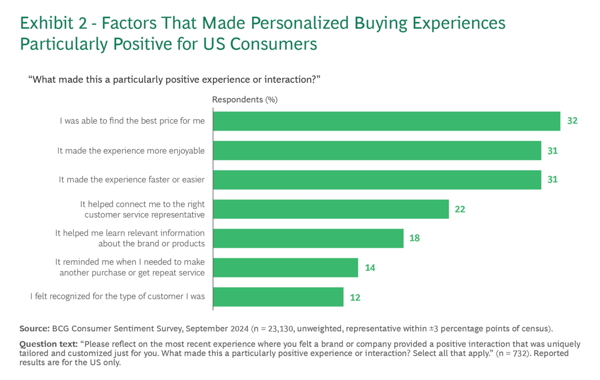
Here’s what delivering personalized experiences in ecommerce means today:
- Dynamic content tailored to shopper preferences
- Personalized product recommendations
- Personalized site search results
- Personalized offers and discounts
- Email and messaging personalization
- Personalized customer support interactions
Recommended reading: Personalized email marketing: top 5 strategies for 2026
2. Effortless product discovery
Data shows that 43% of online shoppers head straight to the search bar when landing on an ecommerce website. And when it comes to product discovery through site search, shoppers expect relevance, speed, and an effortless experience. But this is still far from being a reality for most ecommerce brands that rely on traditional keyword-based search functionality.
Research from Nosto revealed that 41% of shoppers get frustrated when the search results are irrelevant. While more than 80% of brands recognize that fast, accurate site search is critical to ecommerce success, many still lack the key search features required to deliver it.
Here’s additional data from Google Cloud proving the importance of delivering an efficient site search experience:
- 88% of shoppers say a good search function is very important or absolutely essential when visiting a retail website.
- For 69% of shoppers, the search function is the most common way to search for products on retail websites.
- 99% of consumers are likely to return to a website if it has a good search function.
- 85% of global consumers view a brand differently after experiencing search difficulties.
Recommended reading: AI-powered search in ecommerce: what you need to know in 2026
3. Flexible payment options
Delivering a friction-free payment experience is a must for ecommerce brands. Based on research, 76% of US consumers want the ability to use their preferred payment method when shopping online. And when that flexibility is missing, both the customer experience and sales suffer. To meet evolving customer expectations, ecommerce brands are now accepting payments through:
- Shopping apps (PayPal and Shop Pay)
- Buy Now, Pay Later (by integrating services like Klarna, Afterpay, and Affirm)
- Digital wallets (Apple Pay, Samsung Pay, and Google Pay)
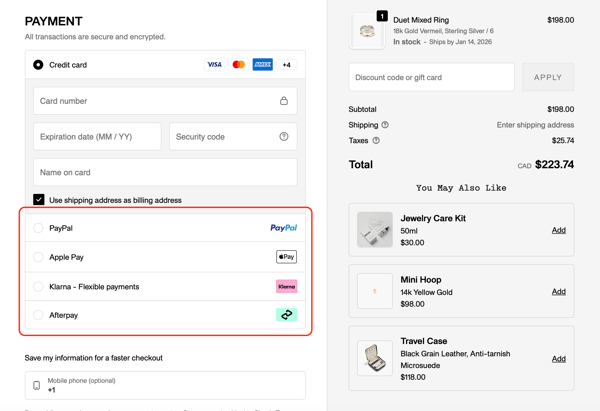
The Buy Now, Pay Later (BNPL) option is becoming particularly popular among Gen Z and Millennials, according to Chargeflow. With rising living costs, flexible installment payment options are seen as less risky and more manageable than traditional credit. What’s more, offering BNPL helps reduce cart abandonment and increase average order values, as BNPL users spend around 6% more than non-BNPL shoppers.
4. Mobile-first experiences
Smartphones are now gradually turning into shopping hubs as more consumers prefer to browse, compare, and buy products directly through their mobile devices. Based on SellersCommerce, in the US alone, around 76% of adults purchase using a smartphone, representing about 200 million mobile shoppers nationwide.
Statista forecasts that mobile commerce will generate approximately $3.4 trillion in sales by 2027, accounting for about 62% of total ecommerce activity.
In 2026, mobile commerce isn’t just an additional channel. It’s the expected way consumers interact with brands online. That means ecommerce brands must prioritize mobile-first design and mobile-optimized experiences (like digital wallets and one-click payments) to meet evolving expectations.
5. Augmented reality (AR)
As shopping behaviors evolve, online consumers now expect more than static product images. They want to visualize, interact, and engage with products before making a purchase. And augmented reality (AR) makes that possible. AR truly bridges the gap between digital and physical shopping, helping consumers make more confident buying decisions, especially in categories where visualization matters, such as beauty, apparel, furniture, and home décor.
Here’s how AR is being used by online retailers today:
- Virtual try-ons: help shoppers see how make-up, apparel, or accessories will look on them in real time.
- 3D product visualizations: enable shoppers to rotate, zoom, and inspect 3D products in AR before buying.
- Real-world placement: lets shoppers preview how furniture, decor, or appliances will look in their home.

IKEA Place AR app
According to Grand View Research, the global augmented reality market in ecommerce was valued at approximately $5.9 billion in 2024 and is projected to reach around $38.5 billion by 2030, driven by the increasing demand for immersive online shopping experiences. And what’s more, by offering AR tools, ecommerce merchants can reduce returns and increase conversions.
6. Social commerce
Social media platforms like Instagram, TikTok, Facebook, and even YouTube are becoming key social commerce channels where product discovery and checkout happen in one place. Today, ecommerce brands can easily set up storefronts directly within their social platforms (e.g., Instagram Shops, Facebook Shops, or TikTok Shop) and let their customers buy products without ever leaving these platforms.
And stats prove that social commerce is on the rise. According to Salesforce, 53% of shoppers now discover products through social platforms, with Gen Z leading the trend, as 76% rely on social media for product discovery. And discovery is just the beginning – 25% of shoppers now go on to complete their purchases directly through social platforms.
Recommended reading: Top 5 ecommerce trends you can’t afford to miss in 2026
7. Livestream shopping
As part of the social commerce trend, livestream shopping is truly gaining momentum. Livestream shopping (or livestream commerce) combines real-time video broadcasting with instant purchasing. During livestreaming events, hosts – often influencers – showcase products, offer flash sales, interact with viewers in real time, answer their questions, and encourage them to buy through integrated checkout.
And this interactivity drives significant conversions. Based on data from Firework, conversion rates for live shopping experiences fall between 9% and 30%, compared with just 2–3% on standard ecommerce platforms.
Here’s where livestream shopping is mostly happening today:
- TikTok Shop: The platform has basically normalized livestream shopping for younger consumers. In fact, nearly half of all TikTok users (48.9%) are actually TikTok Shop buyers.
- Whatnot: On Black Friday 2025, shoppers spent over $75 million on live shopping platform Whatnot, which is three times more than last year, according to EMARKETER.
This shopping format has already transformed retail in China, and it’s quickly scaling in the US as well. In 2025, US livestream ecommerce sales rose by nearly 50% to reach $14.64 billion, while the number of buyers increased 21.5% year over year, based on EMARTER’s data.
8. Instant, 24/7 customer support
Instant is becoming the new response time standard for consumers when it comes to customer support – and brands need to keep up. What was once considered VIP-level service (like immediate replies or always-on support) is now literally the baseline. And beyond speed, of course, consumers expect their issues to be resolved accurately and effectively – otherwise, brands risk losing their loyalty.
Here’s what the Zendesk CXtrends 26 report reveals:
- 68% of consumers expect a quick response time more than they did a year ago.
- 74% of consumers say that, due to AI, they now expect customer service to be available 24/7.
- 86% say fast responses and accurate resolutions highly influence whether they purchase a product or service from a brand.
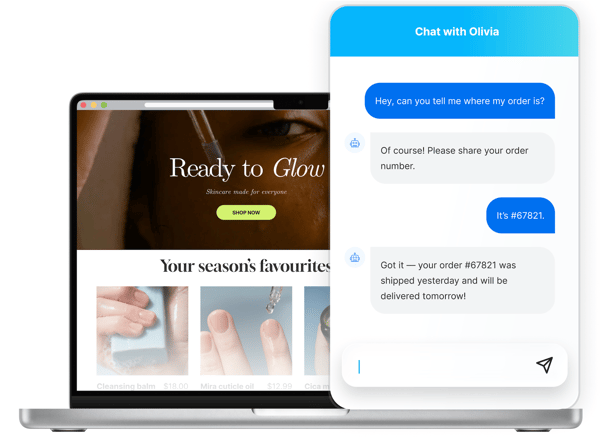
Fortunately, by implementing conversional AI chatbots (AI agents), ecommerce brands can deliver round-the-clock support and help shoppers get their issues resolved instantly without having to rely on their human support team.
9. AI and human assistance working together
Though Gartner predicts that AI will autonomously resolve 80% of common customer service issues without human intervention by 2029, we’re not there yet. While today’s AI chatbots/ AI agents have definitely become much smarter than the basic rule-based bots of the past, they aren’t yet able to entirely replace human agents.
Some of the most advanced AI chatbots for ecommerce can instantly connect and retrieve information from your back-end systems and accurately answer common questions like:
- Where’s my order?
- How do I return this?
- Is this item in stock?
- Why didn’t my promo code work?
Some will even resolve issues independently end-to-end (like changing a delivery address or processing a return). But realistically, the majority of today’s AI chatbots fail way too often, frustrating customers more than actually helping them. That’s why the ability to get support from a real human agent remains essential for consumers.
According to a Qualtrics XM Institute report, half of consumers are concerned that AI will impede their ability to connect to a human. And based on the survey by Ricoh, 85% of consumers are more likely to remain loyal to companies prioritizing genuine human service over automated options only.
10. Experience-driven loyalty
When it comes to customer loyalty, customers’ expectations have changed dramatically – what worked well to capture loyalty just recently won’t cut it anymore. Brands looking to build and maintain lasting relationships with their customers need to understand what drives loyalty today. According to research from SAP Emarsys, here’s what is changing:
- True loyalty is declining: Customer loyalty is becoming more fragile and can no longer be sustained by brand legacy. It now depends on consistent, personalized experiences across every touchpoint.
- Consumers are becoming more trend loyal: Viral trends are creating fast-moving loyalty: 29% of consumers admit they quickly lose interest once a product stops trending (even if they were obsessed with it previously).
- Brand recognition no longer guarantees loyalty: Brand recognition is losing influence, as 64% of consumers prioritize value, relevance, and emotional connection over brand names.
- Batch-and-blast marketing damages loyalty: One-size-fits-all marketing is losing effectiveness, with 23% of consumers saying mass email campaigns actively hurt their loyalty, making relevance more critical than ever.
- Gen Z loyalty is earned, not assumed: Gen Z is reshaping loyalty: 70% say they’re loyal to brands they trust, yet 39% have switched brands over poor sustainability practices.
How Maropost’s unified commerce platform helps you meet customer expectations
In 2026, if you’re not meeting your customers’ expectations, you’re going to lose them to brands that do. Double down on deeper personalization across the entire customer journey, fix your search bar, offer shoppers the flexibility they’re looking for, sell where your customers are, and make sure your brand remains approachable, even if your support is automated and AI-powered.
And here’s how Maropost’s unified commerce platform can help your business stay competitive and deliver the experience your customers have come to expect:
- Personalized cross-channel campaigns: Use engagement data and behavioral insights to send highly personalized email and SMS campaigns that deliver better, more relevant experiences compared to generic one-size-fits-all campaigns.
- AI-powered site search: Make sure your search bar helps users find what they’re looking for faster and more effortlessly with an AI-powered search engine that understands context and shows relevant results, despite typos, misspellings, or vague queries.
- AI product recommendations: Take personalization further by helping shoppers discover more products that match their interests, preferences, and past purchases through AI-powered product recommendations displayed on key website pages and within emails.
- Flexible payment options: Maropost makes it easy for ecommerce merchants to offer multiple payment options, giving shoppers the flexibility to pay how they prefer and reducing friction at checkout.
- Instant support with an AI chatbot: By integrating a conversational AI chatbot built specifically for ecommerce, you can support your shoppers 24/7, ensuring they get instant help whenever they shop, not just when your human team is available.
The best part is that all these features and capabilities are available within a single solution. Book a demo now to see the Maropost Unified Commerce platform in action and discover how it can help your business stay competitive in 2026 and beyond.