

Shopping cart abandonment is a major revenue challenge for ecommerce businesses, but automated cart abandonment emails can recover 10–15% of lost sales by re-engaging high-intent shoppers. This article shares best practices for cart recovery flows and examples of high-converting recovery emails.
Key Takeaways:
-
Cart abandonment emails are automated messages sent to shoppers who leave items in their cart, designed to re-engage high-intent buyers and recover lost sales.
-
Best practices for cart abandonment emails include a timed email sequence, using compelling subject lines and non-pushy CTAs, adding social proof and strategic incentives, and incorporating SMS for higher conversions.
-
Maropost Marketing Cloud enables ecommerce merchants to recover abandoned carts with automated, data-driven email journeys, real-time personalization, and advanced eRFM analytics to optimize messaging and incentives.
When an online shopper adds items to their shopping cart and then just leaves without completing checkout – that’s a nightmare for ecommerce merchants. Unfortunately, this scenario is far too common. And as an ecommerce business owner, you surely know that nearly 70% of shopping carts get abandoned, creating a massive revenue leak. In fact, abandoned carts cause retailers to lose $18 Billion in annual sales revenue.
Now, to be fair, in most cases, cart abandonment happens just because shoppers aren’t really ready to buy yet. According to Baymard Institute, 43% of shoppers leave carts simply because they’re still in “just looking” mode.
On the bright side, you can effectively prevent shopping cart abandonment by reducing friction at checkout (and we covered some proven tactics for doing this in an earlier post).
On top of that, you can recover a significant portion of otherwise lost sales by sending abandoned cart emails. In this blog, we’ll share best practices for creating and sending these messages strategically, along with abandoned cart email examples that actually work.
What are cart abandonment emails?
Cart abandonment emails are automated messages triggered when online shoppers add items to their carts but don’t complete the checkout. They are meant to re-engage shoppers by reminding them about the products in their cart and encouraging them to finalize the purchase through social proof, urgency signals, incentives, or other tactics.
These emails are remarkably powerful sales recovery tools that ecommerce businesses use to improve ecommerce conversion rate and increase revenue because those shoppers have already shown high purchase intent. A well-timed automated reminder (or rather a series of reminders) is very often all it takes to prompt them to return and complete the purchase.
And what’s more, tracking engagement behavior like cart abandonment provides extremely valuable information for ecommerce merchants and enables a smarter ecommerce customer segmentation strategy.
When you know someone is actually close to buying (even though they haven’t purchased yet), you can segment them into ‘highly engaged customers.’ And even if a shopper doesn’t convert after receiving your abandoned cart email, it still signals strong purchase intent, giving you the opportunity to follow up later with relevant offers or promotions.
Abandoned cart email best practices and tips
1. Send multiple emails in an abandoned cart flow
Regardless of why shoppers abandon their carts, you have a very limited window to win them back. Sending an email reminder within an hour of cart abandonment is the most effective way to re-engage them while they are still considering their purchase. It captures their attention when the interest is fresh, and the intent is high, increasing the likelihood of a conversion.
But sending just a single email reminder is where many brands stop – and that’s often their biggest mistake. According to stats published by Marketing LTB, sending 3 recovery emails recovers 37% more carts than 1 email.
Based on our customers’ experience, here’s what an effective abandoned cart email sequence can look like for an ecommerce brand:
-
Email #1 (within 1 hour): The first email is usually a gentle reminder about the items left behind that assumes the shopper just got distracted.
-
Email #2 (24 hours later): The second email may include additional product details, social proof (customer reviews), and shipping/ returns information to address potential concerns.
-
Email #3 (48 -72 hours later): The third email in the sequence may create a sense of urgency with a limited-time offer (free shipping, a discount) or a low-stock notice to nudge the shopper to complete the purchase.
Pro Tip: Even when these cart recovery emails don’t convert, you can still try to re-engage those shoppers later with relevant product recommendations and special offers based on what they showed interest in.
2. Use high-converting subject lines
Considering that 47% of email recipients decide whether to open an email based on the subject line alone, using compelling subject lines in your cart recovery emails is just as important as in any other marketing emails. Plus, data from Campaign Monitor shows that personalized subject lines can increase open rates by up to 26%.
So what makes compelling subject lines? Check out some effective abandoned cart subject line examples:
-
Your [Product name] is waiting for you at [Brand name].
-
Do you still want to buy [Product name]?
-
Your cart has a hard time letting go.
-
Your cart is feeling lonely…🥺
-
You forced your cart to send this reminder.
-
Going fast: grab the treasures in your cart before they go poof.
-
Get your [Product name] before it sells out.
-
Cart expiring in 10…9…8…
-
Choose or lose! Your cart expires soon.
-
[Name], did you check out our 5-star review? 🤩
-
We covered the shipping - just for you! 🫶
-
X% off my shopping cart? Yes, please!
-
You have good taste. 😉 Get it at X% off!
-
[Name], we heard you were interested in [Product name].
-
You’ve come so far, [Name], don’t give up!
-
[Name], should we hold [Product name] for you?
-
Hey [Name], the X items in your cart are waiting for you.
-
Questions about your order? We’re here.
Pro Tip: Relying on your gut feelings alone won’t tell you which subject lines perform best. Ongoing A/B testing helps get a better sense of which subject lines work better with your audience and which ones fall short.
3. Go beyond pushy, generic CTAs
Your CTA (Call to Action) is one of the most important elements of your abandoned cart emails. CTA buttons serve a single purpose – to get shoppers back to their carts. But at the same time, you don’t want to be too pushy.
Instead of using standard ‘Buy now’ or ‘Complete your order,’ you may want to get a bit more creative and frame your CTAs more like a friendly reminder, encouraging shoppers to return to their cart rather than complete the checkout. Here are some non-pushy CTA examples that work well in cart abandonment emails:
-
Return to your cart
-
Take another look
-
Keep shopping
-
Pick up where you left off
-
Back to your selections
-
Resume checkout
-
Claim your items
-
Take me back
-
Make it yours
-
Your cart’s still here
Pro Tip: Adding words like ‘you’ and ‘yours’ in the CTA button copy helps create a sense that the shopper already owns the items they left in their cart – and all that’s left is to complete the final step and just make it official.
4. Add value with social proof and relevant context
Shopping cart abandonment is often driven by hesitation, whether it’s a lack of trust, concerns about shipping and returns, or anything else in between. While you might not want to overwhelm shoppers with extra information in the first reminder, the second email in your abandoned cart flow can include details like:
-
Product specifications to reinforce value
-
Customer reviews and star ratings to provide social proof
-
Delivery timelines and shipping details to set clear expectations
-
Payment options available (like Buy Now Pay Later)
-
FAQs about returns and exchanges to address common concerns
-
Product recommendations to increase relevance
-
Customer support information to build trust
Pro Tip: Including dynamic product recommendations in your cart recovery emails based on cart value, browsing behavior, and past purchases – instead of generic ‘bestsellers’ – can increase both your conversion rates and average order value (AOV).
5. Offer incentives more strategically
Unexpected costs (like taxes and shipping fees) are the second most common reason shoppers abandon their carts at checkout. Offering incentives, such as a limited-time discount or one-time free shipping, is an effective abandoned cart email strategy to win some of those shoppers back.
Better yet, by using eRFM analytics to segment customers based on engagement, recency, frequency, and monetary value, you can tailor incentives more strategically, for example:
-
Free shipping for first-time buyers
-
Loyalty points for repeat customers
-
Limited-time discounts for low engagement segments
Pro Tip: While discounts can drive short-term conversions, don’t use them too frequently, as they may train customers to abandon carts on purpose. Beyond that, don’t offer incentives in the first email reminder – save them for the end of your recovery flow as a final push to convert.
6. Add SMS to your abandoned cart flow
Sending timely cart recovery emails is the foundation of your cart recovery strategy, but the best cart recovery campaigns involve multiple channels. In fact, based on data from Omnisend, campaigns that use three or more marketing channels generate a 287% higher purchase rate than single-channel ones. Additionally, adding SMS to your campaign mix can boost the likelihood of conversion by 47.7%.
Considering that SMS has a 98% open rate, and nearly 90% of text messages are read within three minutes of delivery, it’s a powerful channel to use in your cart recovery campaigns. Here’s what your cart abandonment flow might look like if you add SMS:
| Step | Timing | Channel | Goal | Key elements |
| 1 | 30–60 minutes 30–60 minutes | Gentle reminder | Cart details, clear CTA, no discount | |
| 2 | 4–6 hours (if no purchase) | SMS | Quick nudge | Short message, punchy text with a direct cart link |
| 3 | 24 hours | Reinforce value | Customer reviews, product benefits, shipping/returns info | |
| 4 | 48–72 hours | Email or SMS | Create urgency | Limited-time incentive, low-stock notice, strong CTA |
Pro Tip: When sending SMS cart recovery messages, make sure to comply with local regulations and privacy laws. For example, in the U.S., that includes obtaining express consent (ideally through double opt-in), limiting cart abandonment flows to one SMS sent within 48 hours of the trigger event, and adding proper disclosures.
Download the playbook: How ecommerce brands turn lost checkouts into revenue
Best cart abandonment email examples (and why they work)
1. Dyson
Subject: Items in your basket at dyson.com
Why it works: It immediately reminds shoppers of the exact product they left behind, uses a non-pushy CTA (“Continue shopping”), adds light urgency without being aggressive (“This offer is only for a limited time”), reinforces value with benefits like a 30-day money-back policy and free 2-day delivery, and even includes a chat link to connect with a Dyson expert.
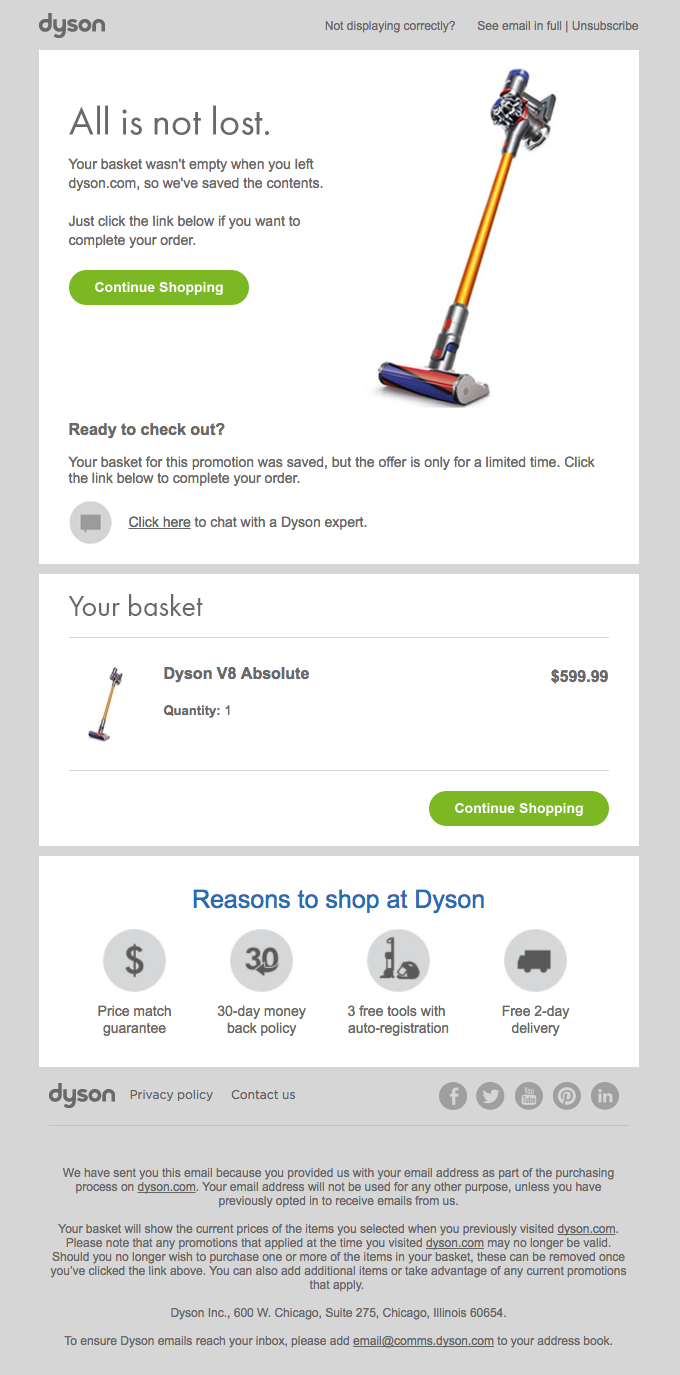
Image source: Good Emails
2. Fable
Subject: Free Shipping, Just For You 🕊
Why it works: It leads with a clear incentive (free shipping) to lower friction, brings shoppers back to the exact item waiting in their cart, adds soft urgency (“before they find a new home”), reduces risk with a 30-day money-back guarantee, and reinforces trust through testimonials and 14,000+ five-star reviews.
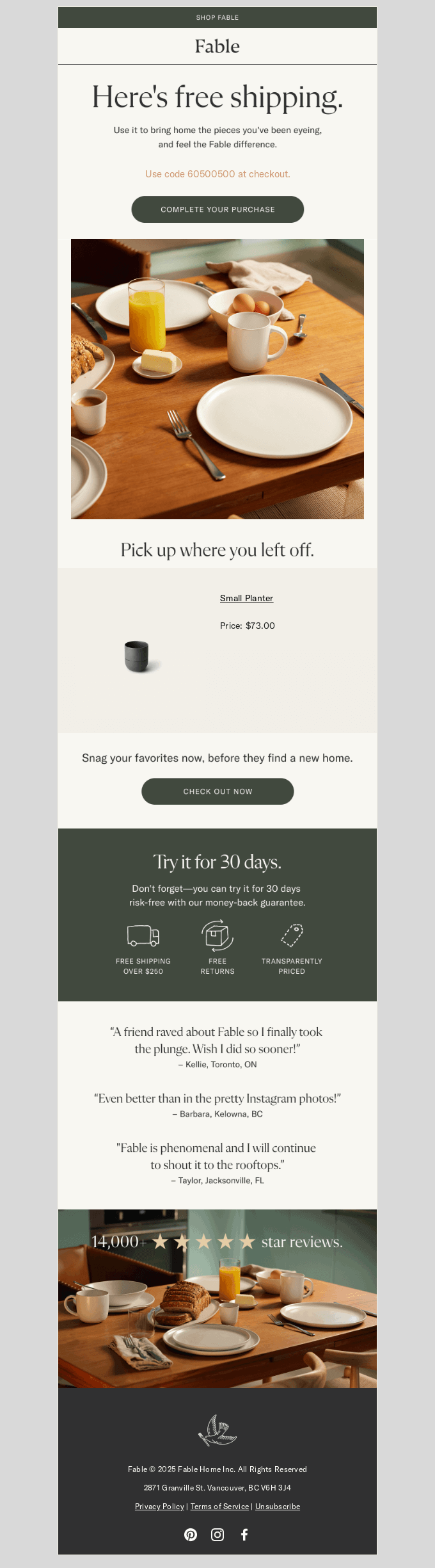
Image source: Good Emails
3. Echo
Subject: 💧Thirsty for more?
Why it works: It opens with a playful, attention-grabbing headline, highlights the product left in the cart, includes a low-pressure CTA (‘Return to Cart’), emphasizes key product benefits, strengthens credibility with a five-star testimonial and risk-reducing signals like a 30-day money-back guarantee, easy returns, and access to live customer service.
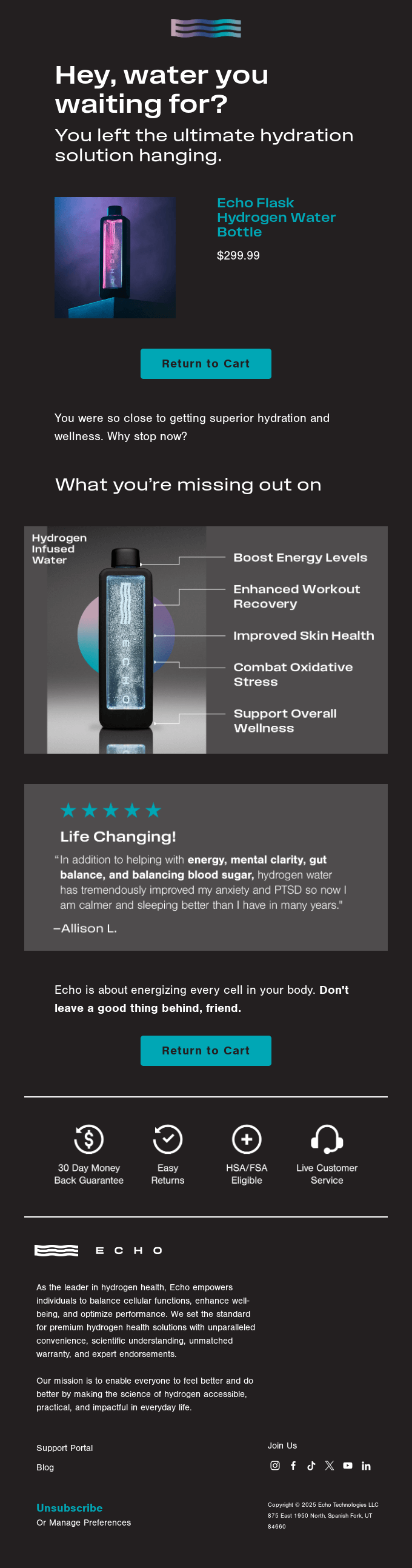
Image source: Good emails
Turn abandoned carts into successful checkouts with Maropost Marketing Cloud
Shopping cart abandonment isn’t going away – that’s just the reality of how people shop online. But with the right approach and strategy, ecommerce merchants can turn those abandoned carts into re-engagement opportunities that actually drive serious revenue.
Success depends on the right timing, messaging, personalization, and channel mix. Fortunately, using one of the best email marketing platforms brings that strategy to life. Maropost Marketing Cloud can help you reach the right people at the right time, with the right messaging, when carts get abandoned.
With Marketing Cloud, you can easily set up automated abandoned cart journeys where every email shows the exact abandoned products with real-time pricing, inventory, and personalized recommendations, helping you turn abandoned carts into completed orders.
On top of that, advanced eRFM analytics enables you to segment high-value carts from low-value carts, so you can better tailor your messaging, incentives, and follow-up strategy based on purchase intent, engagement, and customer value.
Book a demo to see Maropost Marketing Cloud in action and learn how it can help you recover lost sales with highly personalized cart abandonment campaigns.
Frequently asked questions
How effective are abandoned cart emails?
Well-crafted and timely abandoned cart emails are effective because they target shoppers with high purchase intent. Based on statistics:
-
Sending abandoned cart emails can help recover 10–15% of lost revenue
-
45% of cart abandonment emails are opened
-
21% are clicked after opening
-
50% of those clicks lead to a recovered purchase
When optimized with timely delivery, personalization, and compelling incentives, abandoned cart emails can become one of the highest-converting email marketing strategies for ecommerce businesses.
What is the main reason for abandoned carts?
According to data from the Baymard Institute, the main reason online shoppers abandon their carts is that they’re simply browsing and not yet ready to make a purchase. Some other common reasons include unexpected costs at checkout, slow delivery times, lack of trust, mandatory account creation, complicated checkout process, unsatisfactory return policy, and others. More specifically, here’s how the reasons break down by percentage of shoppers:
-
Just browsing/ not ready to buy – 43%
-
Extra costs too high (shipping costs, etc.) – 39%
-
Delivery was too slow – 21%
-
Didn’t trust the site with my credit card – 19%
-
Had to create an account – 19%
-
Too long/ complex checkout process – 18%
-
Return policy wasn’t satisfactory – 15%
-
Website had errors/ crashed – 15%
-
Couldn’t see total order cost upfront – 14%
-
Not enough payment options – 10%
-
Credit card was declined – 8%
When should you send abandoned cart emails?
The best practice is to send the first email reminder within an hour of cart abandonment when the intent is still high, and interest is fresh. Sending the first reminder too soon may feel intrusive, while waiting too long may result in lost momentum.
The second email in the abandoned cart sequence is usually sent 24 hours later, reinforcing the value of the products and addressing potential objections. The third email is typically sent 48–72 hours after abandonment and may introduce a limited-time incentive or a low-stock notification to create urgency.
What makes a good abandoned cart email?
A good cart abandonment email is timely and personalized. It should have a high-converting subject line and include the exact products left in the cart, compelling email copy, high-quality product images, and a strong call-to-action.
The best abandoned cart emails also incorporate social proof (like customer reviews or ratings) to build trust with shoppers and incentives (like free shipping or limited-time discounts) to overcome price sensitivity. More importantly, cart abandonment emails should be sent as a sequence, with each email offering slightly different messaging or value.
How do you set up a cart recovery email flow?
To set up a cart recovery email flow, your ecommerce platform needs to be integrated with your email marketing tool to sync real-time customer data and cart triggers. Once connected, you can set up an automated sequence (usually 2-3 emails) triggered when a shopper adds items to their cart but doesn’t complete the transaction within a specific timeframe. Most email marketing services also offer ready-made abandoned cart email templates that you can customize to match your brand and goals.