
Ecommerce conversion rate optimization helps you improve your conversion rates without increasing your marketing budget or (better yet) bringing in more traffic to your online store. Sounds like every marketer’s dream, doesn’t it? But how do you actually make that happen?
Well, in 2026, ecommerce conversion rate optimization goes far beyond basic tactics that used to work – and used to be enough – years ago. Why? Because competition in ecommerce is getting more aggressive, while consumer expectations are skyrocketing.
In this blog, we won’t be talking about the all-too-obvious ecommerce conversion rate optimization tactics like writing compelling product descriptions, optimizing your site load times, or offering free shipping.
Instead, we’ll outline the top 5 CRO strategies that go beyond simple tactics and work especially well in 2026 because they align with today’s customer expectations. And implementing even just one of them can actually have a major impact on your ecommerce conversion rate.
TL;DR
- Ecommerce conversion rate optimization (CRO) is the process of increasing the percentage of website visitors who complete desired actions, such as making a purchase.
- A good conversion rate in ecommerce typically ranges from 1–4%, depending on the product category, with lower-cost items converting higher than more expensive ones.
- In 2026, the most effective ecommerce CRO strategies include AI-powered site search and recommendations, frictionless checkout, conversational chatbots, and omnichannel cart abandonment campaigns.
- Maropost offers powerful features ecommerce businesses need to improve conversion rates (AI search & product recommendations, cross-channel campaigns, AI chatbots, and more).
What is ecommerce conversion rate optimization (CRO)?
Ecommerce conversion rate optimization (CRO) is the systematic process of increasing the percentage of your website visitors who take a desired action on your online store – most commonly, making a purchase. When done right, conversion rate optimization makes it easier for marketers to hit their conversion benchmarks by turning more of the traffic they’re already getting into paying customers.
Typically, ecommerce conversion rate optimization means improving these key areas:
- User experience (UX): Creating a smooth shopping journey with clear site navigation and search, fast-loading pages, and mobile-friendly design.
- Product pages: Showcasing high-quality product images/ videos, detailed, benefit-driven descriptions, and clear pricing and shipping information.
- Social proof: Displaying customer reviews, star ratings, testimonials, user-generated content, and trust badges to build credibility.
- The checkout process: Offering guest checkout, minimizing form fields, and providing multiple payment methods.
What is a good conversion rate in ecommerce?
There is no single universally accepted benchmark for a good ecommerce conversion rate. But according to data from Adobe, on average, ecommerce websites should expect to see a conversion rate of 1% to 4%. Mostly, that depends on the industry vertical.
For example, lower-cost items across food, beauty, and apparel sectors typically have higher conversion rates as shoppers are less hesitant to spend less money. Higher-cost items like electronics or home furnishings have lower conversion rates because of higher prices and longer consideration cycles. Based on Adobe’s data, these are the average conversion rates for the top 6 ecommerce verticals.
| Ecommerce vertical | Average conversion rate |
|---|---|
| Fashion and apparel | 2.7% |
| Health and beauty | 3.3% |
| Entertainment | 2.5% |
| Household goods | 2.1% |
| Electronics | 1.9% |
| Food and beverage | 4.6% |
5 High-impact strategies for ecommerce conversion rate optimization in 2026
Let’s now go over the top 5 CRO strategies for ecommerce businesses that can instantly drive impact:
1. Improve product discovery with AI-powered site search
Search abandonment is a silent conversion killer – yet most ecommerce businesses don’t even realize that. Based on Google Cloud’s data, search abandonment costs retailers over $2 trillion annually worldwide. When shoppers can’t find what they’re looking for on your ecommerce website, you’re quietly losing conversions and revenue. Just take a look at the stats from the Google Cloud’s research:
- 78% of US consumers view a brand differently after experiencing search difficulties.
- 82% of US consumers avoid websites where they’ve experienced search difficulties in the past.
- 9 in 10 consumers say a good search function is very important or absolutely essential for retail websites.
- 69% of consumers use the search function on retail websites, making it the most common way to find products.
- Only 1 in 10 consumers say they find exactly what they’re searching for every time.
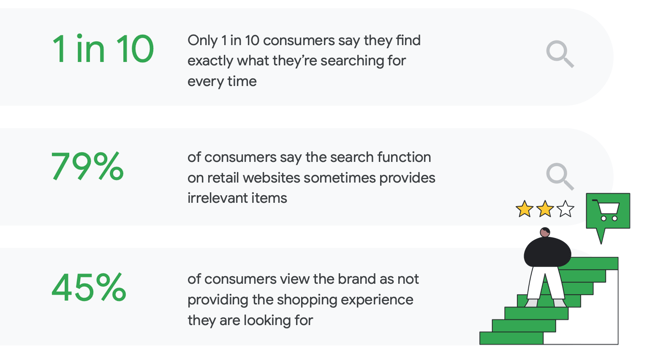
Image source: Google Cloud
The problem is that most ecommerce brands still rely on traditional site search functionality that is based on keyword matching. It means that when shoppers don’t use your exact product language, search breaks down, serving irrelevant results or none at all. And that creates a frustrating experience and lost conversions. AI-powered site search fixes that.
Here are some key capabilities of AI-powered site search engines:
- Autocomplete and query suggestions (helps shoppers find products faster by predicting and suggesting searches as they type)
- Spell correction and typo tolerance (still shows the right products even when a shopper misspells a word)
- Zero-results prevention (shows close matches or relevant alternatives to avoid showing zero search results)
- Semantic search (understands what shoppers mean, not just the exact words they use)
- Personalized search results (shows products based on each shopper’s past behavior and interests)
- AI-based relevance ranking (orders search results so the most likely-to-convert products appear first)
According to research from Nosto, the vast majority of ecommerce brands are still missing key search functionality on their ecommerce websites, including error tolerance, personalized results, autocomplete, and alternative product recommendations when searches return no results. Ultimately, this means that implementing an intelligent, AI-powered site search is not only a powerful way to boost your conversion rates but also to differentiate your brand.
Recommended reading: AI-powered search in ecommerce: what you need to know in 2026
2. Inspire more conversions with AI product recommendations
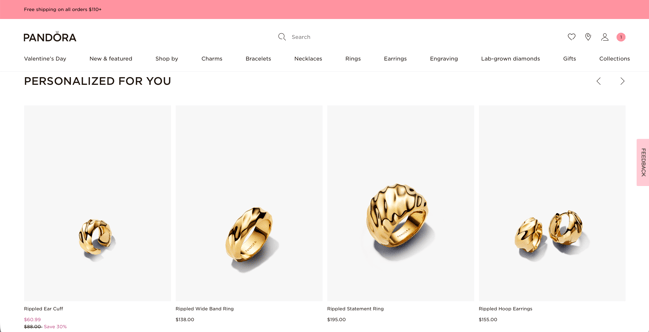
Implementing AI product recommendations on your ecommerce website is another impactful way to enable better product discovery and increase conversions. These are on-site widgets embedded into website pages (usually product category and checkout pages) that dynamically showcase relevant products to shoppers.
Some common recommendation widget examples are:
- “Similar products”
- “You might also like”
- “Recommended for you”
- “Frequently purchased together”
AI product recommendation engines use AI and machine learning algorithms to analyze shopper browsing behavior, purchase history, and engagement patterns to automatically suggest the most relevant products. Behind the scenes, AI recommendation systems provide suggestions based on these approaches:
- Collaborative filtering: suggests products based on patterns across many customers, such as items frequently bought or viewed together.
- Content-based filtering: recommends products similar to those a shopper has already shown interest in based on product attributes.
- Hybrid filtering: combines both approaches to deliver even more accurate and relevant product recommendations.
The best thing about AI product recommendations is that they don’t just help improve conversions. They also increase average order value (AOV) through cross-selling and upselling, because shoppers are encouraged to buy more products that naturally complement what they were already looking for.
Recommended reading: AI product recommendations: the key to boosting your ecommerce sales
3. Make your checkout process quick and ridiculously effortless
According to data from SellersCommerce, ecommerce stores lose $18 billion in sales revenue annually because of cart abandonment. That’s a huge number. Of course, a significant share of cart abandonment happens naturally as part of how people shop online. Many users are just browsing, comparing prices, saving items for later, or looking for gift ideas. These cart abandonments are often unavoidable.
But in many other cases, shoppers abandon their carts due to issues related to an inefficient checkout process. More specifically, some of the most common reasons for cart and checkout abandonment include:
| Reason to abandon online shopping cart | Share of people |
|---|---|
| Additional charges at final checkout (shipping, tax) | 48% |
| Mandatory account creation before checkout | 26% |
| Lack of trust on the site with credit card information | 25% |
| Long or complicated checkout process | 22% |
| Not enough payment methods | 13% |
And these issues can easily be resolved. Here’s how you can improve the checkout experience process and recover conversions that would otherwise be lost:
- Minimize unnecessary fields: Ask only for the essential information (shipping and payment details) to reduce friction.
- Enable autofill: Let shoppers use auto-complete for their shipping and payment details to speed up form completion.
- Allow guest checkout: Forcing shoppers to create an account during the checkout process causes 34% to abandon their cart.
- Enable one-click checkout: Based on Shopify, enabling one-click checkout has been proven to increase conversion rates by 35%.
- Offer a buy now, pay later (BNPL) option: BNPL can increase conversions and boost average order values for merchants by 20–40%.
- Build trust with security signals: Show secure payment badges, SSL indicators, and clear return policies.
- Remove visual clutter: Avoid unnecessary elements that can cause distraction and drive shoppers away from the checkout page.
Recommended reading: How to boost your checkout conversion rate in 5 easy steps
4. Implement an AI chatbot to support shoppers at key moments
Over the past couple of years, AI chatbots have mostly been seen as customer support automation tools. But that’s rapidly changing. For ecommerce brands in particular, AI chatbots have become powerful sales tools that can help increase website conversions. Today’s AI chatbots can instantly retrieve accurate, up-to-date information, engage users in a natural, conversational way, and turn more visitors into real sales.
Here’s how conversational AI chatbots can improve your conversion rates:
- Real-time shopping assistance: AI chatbots can support shoppers by answering common questions about your products, shipping, and return policy right when they are browsing your website, helping them make more informed purchase decisions. According to SellersCommerce, 24% of US consumers regularly use chatbots while shopping, while 45% value them for providing instant answers to their questions.
- Product recommendations: Ecommerce AI chatbots aren’t just great for providing pre-sales support. Some solutions can offer personalized product recommendations and suggest relevant products based on user preferences and past purchases, helping you improve conversions while also increasing average order values.
- Immediate checkout help: Nearly 70% of shopping carts are abandoned. And as you’ve seen from the stats above, this often happens at the checkout stage. An AI chatbot can help shoppers clarify shipping information and return policy, assist in resolving payment issues, and ultimately increase your checkout conversion rate.
- Proactive cart abandonment recovery: Multiple studies have proved that ecommerce chatbots can cut cart abandonment by 20-30%. AI chatbots can proactively remind shoppers about abandoned carts and encourage them to finalize the purchase by offering discounts or special incentives.
5. Go beyond emails and set up cross-channel abandoned cart campaigns
Setting up campaigns to recover abandoned carts is a popular and highly effective CRO strategy in ecommerce. However, most brands follow the same formula: wait an hour, send an email reminder, wait a day, send another follow-up email, and often stop there. But if your cart abandonment campaigns rely solely on emails, you’re missing out on the opportunity to re-engage shoppers who may not engage with emails.
The most effective cart recovery campaigns involve multiple channels. In fact, omnichannel campaigns have proven to significantly outperform single-channel ones. According to data from Omnisend, omnichannel campaigns (3+ channels) deliver a 287% higher purchase rate compared to single-channel campaigns. And what’s more, campaigns that include SMS are 47.7% more likely to convert.
Some of the best practices for effective cart abandonment campaigns include:
- Treat each channel differently: While your messages across email, SMS, and push should be consistent, they shouldn’t feel repetitive. Each channel should add value (e.g., email for details, SMS for urgency, and on-site messages for real-time assistance).
- Create urgency without pressure: While it’s definitely a good practice to add urgency signals to your messages (such as low-stock indicators, limited-time offers, or cart expiration reminders) to encourage action, avoid using aggressive language that can feel too pushy.
- Go for personalization: Make sure to include the exact products left in the cart, pricing, images, and availability. Additionally, use browsing behavior, past purchases, and location data to make messages feel even more relevant and timely.
- Segment by cart value: For example, for high-value carts ($100+), you might set up a more aggressive flow (push + email + SMS), while for low-value carts (under $50), a passive flow (email only) is usually enough.
Here’s what an effective cross-channel cart abandonment flow might look like:
| Stage | Trigger | Action | Goal |
|---|---|---|---|
| Stage 1 | T + 30m | Push notification (app users only) | Drive instant recovery with a quick, low-friction reminder |
| Stage 2 | T + 1–2h | Email #1 (if no conversion) | Re-engage with product details, images, and trust signals |
| Stage 3 | T + 24h | SMS (if Email #1 unopened or no click) | Add urgency with a short reminder |
| Stage 4 | T + 48–72h | Email #2 (final reminder) | Reinforce urgency or introduce a limited-time incentive |
Download the playbook: How ecommerce brands turn lost checkouts into revenue

Image source: Really Good Emails
Next steps: improve your ecommerce conversion rate with Maropost
Knowing how to improve your ecommerce conversion rate is only half the equation. The other half is actually implementing those tactics and strategies using the right tools. And that’s where Maropost’s unified commerce platform comes into play. Here’s how you can leverage Maropost’s capabilities to improve your ecommerce conversion rate:
- AI-powered site search: Improves product discoverability and delivers highly relevant search results, enabling shoppers to find what they want faster.
- AI-product recommendations: Uses customer behavior and purchase data to suggest relevant products that increase conversion rates and average order value.
- Smart collections: Automatically re-orders products on category pages to show the highest-converting or highest-margin items first.
- Smooth checkout: Reduces friction at checkout with a fast, intuitive experience that helps minimize drop-offs and abandoned carts.
- Cross-channel campaigns: Orchestrates personalized messaging across email and SMS to re-engage shoppers and drive higher conversions.
- Conversational AI chatbot: Supports shoppers in real time by answering common questions and removing purchase blockers.
Book a demo now to experience the Maropost Unified Commerce platform in action and see how it can help you improve your ecommerce conversion rates through AI and automation.