
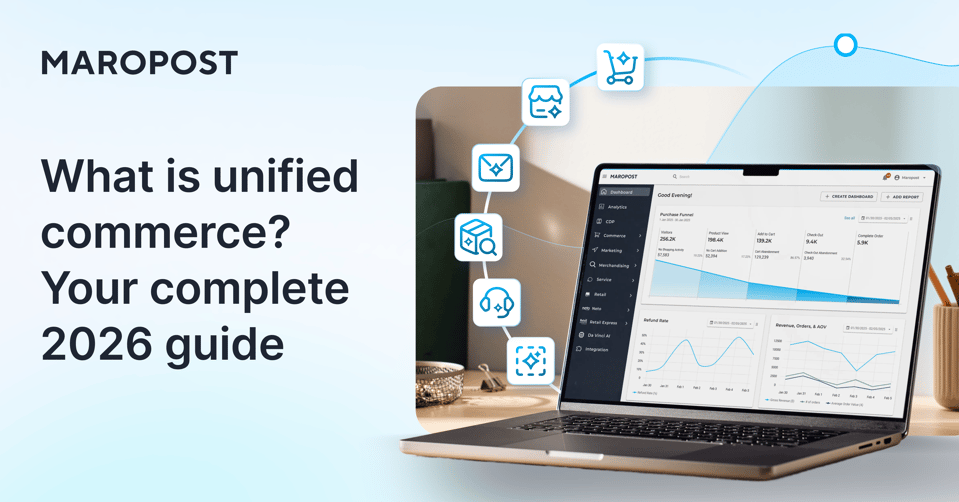
Unified commerce is one platform, and one customer record, running the parts of a business that usually sit in separate tools: the online store, the point of sale, email and SMS marketing, site search, and customer support. One system holds the order history, inventory count, and customer profile. Your store staff, marketing team, and support desk all work from that record instead of from five separate versions of it that somebody has to reconcile.
The absence of it shows up in small disagreements between systems. A cart total that doesn't match the register. A support ticket that doesn't show the order already shipped. A win-back email to someone who ordered yesterday. Each one is the same customer record, remembered differently in five places.
Adding channels is the easy part. Keeping them from disagreeing about the same customer is the hard part, and that's what every unified commerce definition comes back to.
Key takeaways
- Unified commerce is about shared data, not the number of channels you operate. One record, read and written by every part of the business.
- Connected tools sync on a schedule, so there's always a window where they disagree. A unified commerce platform closes that window by keeping one copy of the data that every channel reads and updates in real time.
- Omnichannel describes what the shopper experiences. Unified commerce describes the architecture that makes it hold up.
- Multichannel is where most retailers start, and the reconciliation cost grows faster than the channel that created it.
- In practice, it covers five areas: store, POS, email and SMS, site search, and support. Each one can act on what the others already know, because they all read and write the same record.
The reality of unified commerce
The concept is one platform for every part of the business, not five tools glued together. In practice, a unified commerce platform covers five areas that, in most stacks, come from five separate vendors:
- Building and running the online store
- Point of sale for in-store selling
- Email and SMS marketing, promotional and transactional, plus reporting on what those sends did
- Site search, including the faceted navigation that lets a shopper filter by size, color, or price
- Customer support and help desk, so a service rep sees the same order and account history as everyone else
None of those five is unusual on its own, and most vendors sell one or two of them well. The hard part is the connective tissue: getting a POS, an email platform, a search engine, and a help desk to agree on what a customer is, in real time, without someone on staff maintaining the integrations that hold it together.
That's the actual work behind a unified commerce strategy: reducing the number of places the same fact about a customer has to live.
A typical stack has Shopify running the store, with a separate POS, email tool, help desk, and search vendor around it. The licenses are rarely the expensive part. Some of the cost is the engineering time spent keeping five systems in agreement. The rest of it reaches the customer: overselling an item the store moved an hour ago, refunding the same order twice, promoting a product that's out of stock, or asking someone to repeat their order number to three different people. Those are the expensive ones, because they cost revenue and the customers who would have come back, and they're usually what sends a team looking at unified commerce solutions.
One thing worth checking while you shop for unified commerce software is how the platform was built. Many unified commerce platforms were assembled through acquisitions, which means the pieces don't always share the same foundation beneath the branding. Ask a simple question: do these systems write to a single customer record, or are they synchronizing data between separate systems?
Omnichannel vs unified commerce
Omnichannel is about the customer's experience. Can someone start a return online and finish it in-store? Do they see the same promotion in the app and in an email? It measures whether the channels feel consistent to the shopper.
Unified commerce is the infrastructure behind that experience. A business can attempt an omnichannel experience on disconnected systems, and it usually means nightly batch jobs and manual work holding the illusion together. When the data is single-sourced, that consistency is built into the systems instead of maintained by hand.
Multichannel vs omnichannel vs unified commerce
In an omnichannel vs multichannel comparison, multichannel is usually cast as the mistake to fix. It's more accurate to treat it as the stage most retailers start from.
| Multichannel | Omnichannel | Unified commerce | |
|---|---|---|---|
| Customer data | Separate per channel | Partially shared, often manually | One record, shared automatically |
| Inventory | Tracked per channel | Reconciled on a schedule | Updated in real time from one source |
| Customer experience | Inconsistent across channels | Consistent by design effort | Consistent because the data is single-sourced |
| Adding a new channel | Another system to integrate | Another integration to maintain | Another surface reading the same platform |
Multichannel is usually how a business grew: a website first, then a store, then a marketplace listing. Each justified by its own revenue at the time, each with its own inventory count and customer list.
The cost shows up later. Every new channel is another system to keep in sync, and the reconciliation work grows faster than the revenue that justified adding the channel. That's the point where "which platform actually connects these" stops being a nice-to-have question and becomes an operational one.
A quick way to place your own business:
- Multichannel. The website, store, and marketplace each close orders the others can't see.
- Omnichannel. A shopper can move between the website, the store, and the marketplace, and the experience mostly holds, even when inventory and marketing catch up on a delay.
- Unified commerce. A return at the register, a support ticket, and a replenishment email are all reading the same order, and they see it change in real time.
What unified commerce looks like at Maropost
Maropost started using the term unified commerce ahead of many companies, and built toward the idea behind it at the same time. The goal was always the same: bring commerce, marketing, and service together on shared customer data instead of passing information between disconnected systems. Most software vendors focused on solving a specific business function, making integrations the standard way to connect commerce, marketing, and service. Maropost took a different approach, building those functions to work together as part of the same platform.
At Maropost, that means five Clouds working off one customer record:
- Commerce Cloud. The eCommerce platform and storefront builder behind online selling. One catalog, one set of pricing, and one inventory count can run multiple storefronts, brands, and regions, with stock and orders visible in real time.
- Retail Cloud. Point of sale and inventory, syncing stock, orders, and fulfillment across every store and channel in real time, so what an associate sees on the register matches what's published online. Returns for orders placed online are handled in-store.
- Marketing Cloud. Email marketing software and SMS marketing in one platform, running on the same customer and order data, with automated journeys, segmentation that updates as behavior changes, and analytics tying each send back to orders.
- Merchandising Cloud (formerly Findify). eCommerce site search, faceted navigation, category merchandising, and product recommendations, ranked by how shoppers actually browse and buy rather than by static rules.
- Service Cloud. Help desk software where every ticket is tied to one customer record, so an agent answering a question can see the contact, their past tickets, and their order history.
Put together, one shopper can touch all five without anyone re-entering anything:
- They search for a winter jacket. Merchandising Cloud doesn't simply return products containing the keyword. It ranks results using shopper behavior and search intent, so high-intent shoppers reach what they're most likely to buy.
- They order. Commerce Cloud draws the unit from one inventory count that every storefront and store reads, so the business doesn't sell stock it no longer has.
- Two weeks later they return the jacket in a store. The associate retrieves the online order by email address, because Retail Cloud reads the order that Commerce Cloud created. The refund goes to the original payment method and the unit is credited back to store inventory.
- The purchase had started a post-purchase journey recommending pieces to wear with it. Marketing Cloud segments on the order data the return updated, so those sends stop without anyone rebuilding a list.
- They email to ask when the refund will land. Service Cloud logs the ticket against the same contact record, so the agent sees the return and the refund method and answers on the spot.
That's unified commerce in practice: one record accurate enough that every team can act on it without checking a second system first. When every team works from the same information, shoppers find what they're looking for, inventory stays trustworthy, marketing stays relevant, and support can resolve issues faster.
Ready to get your channels working together? Start your free trial on the Maropost unified commerce platform.