Maropost Marketing Cloud vs. ActiveCampaign 2026
Quick comparison at a glance
Bottom line: Both run automations from a contact record, and both offer a dedicated IP. Marketing Cloud is the better fit when purchase-based send timing, Priority Send, and eRFM scores (Essentials and up) matter more than sales deals and pipeline lead scores in the same product, and when the price needs to hold as the list grows.
| Criteria | Maropost | ActiveCampaign |
|---|---|---|
| Core product | Email, SMS, and automations on one contact record. Email is included, and SMS is an add-on | Email, automations, and a CRM in one product. SMS and WhatsApp require add-ons |
| Best for | Growing and scaling eCommerce brands and high-volume senders that want purchase-based timing and Priority Send | Small and mid-sized businesses that need sales deals and lead scores, which require the pipelines and sales engagement add-on (Plus and up) |
| Key differentiator | Purchase-based send timing, Priority Send, and eRFM (Essentials and up) | No purchase-based send timing is documented. Predictive sending uses opens and is limited to Pro and Enterprise. Deals, lead scores, and WhatsApp require a Plus add-on |
| Integrations | Salesforce import of leads and contacts, plus an API and webhooks | 1,000-plus apps, an API, and webhooks, including WooCommerce. Salesforce is limited to Enterprise |
| Support | 24/7 chat on every plan. Success and deliverability managers on higher plans | Email and chat limited to published hours, with a ticket outside those hours, priority support starting on Pro, and a dedicated account team requiring Enterprise |
| Pricing | Build $29, Essentials $240, Professional $720, Enterprise $1,440 a month (annual billing, except Build). Essentials includes 250,000 contacts and 2 million emails | Rises with list size: $20 to $196 a month at 1,000 contacts and $822 to $1,578 at 50,000, billed yearly. Custom above 50,000. Plans differ in features |
| Plan shape | Included contact and email-send allowances, not a multiple of list size | Monthly sends limited to 10× contacts on Starter and Plus, 12× on Pro, and 15× on Enterprise |
| Getting started | 14-day free trial, no credit card, then a published plan | 14-day free trial, no credit card, then a published plan |
Plan callout: Both offer a dedicated IP, transactional email, SMS, and a 14-day free trial with no credit card. Marketing Cloud publishes Build, Essentials, Professional, and Enterprise. ActiveCampaign publishes Starter, Plus, Pro, and Enterprise. Monthly sends are capped at 10 times the contact count on Starter and Plus, 12 times on Pro, and 15 times on Enterprise.
The main difference
What is the main difference between Maropost and ActiveCampaign email marketing?
You can send lifecycle email on both. Both offer a dedicated IP, transactional email, SMS, Salesforce, product catalog content, send-time optimization, and inbox previews. On ActiveCampaign, product catalog content, send-time optimization, and inbox previews are limited to Plus and above, and Salesforce is only on Enterprise. Marketing Cloud can time a promotional send for when each contact is most likely to buy, based on their purchase history, and score that contact with eRFM (Essentials and up).
Both email marketing tools give you a drag-and-drop email builder, forms, A/B tests, store connections, and automations. Both cover list growth, campaign sends, abandoned cart recovery, and reporting.
The split sits in three places: purchase-based send timing, Priority Send, and eRFM (Essentials and up) on Marketing Cloud; sales deals, pipeline lead scores, and WhatsApp on ActiveCampaign; and cost as the list grows, where ActiveCampaign’s price rises with contact count and Marketing Cloud’s follows plan allowances.
What is Maropost
The Maropost email and SMS marketing platform (Marketing Cloud) runs campaigns and automations from the same contact record. A send can be timed from purchase history. It supports online stores, retail, and every other kind of business.
At a glance
What is ActiveCampaign
Email, marketing automation, and a sales CRM for small and mid-sized businesses. Deal records and pipeline lead scores can sit on the contact, in the same product as the campaign. Those tools are an add-on from Plus. The published email plans cover email and automations.
At a glance
The real difference: eCommerce marketing versus built-in sales tools
ActiveCampaign ActiveCampaign automates from the contact record. Sales deals, pipelines, and lead scoring can sit alongside marketing automation, with CRM features available on higher plans. WhatsApp is available as an add-on from Plus. Predictive sending, limited to Pro and Enterprise, aims to send messages at each contact's preferred time.

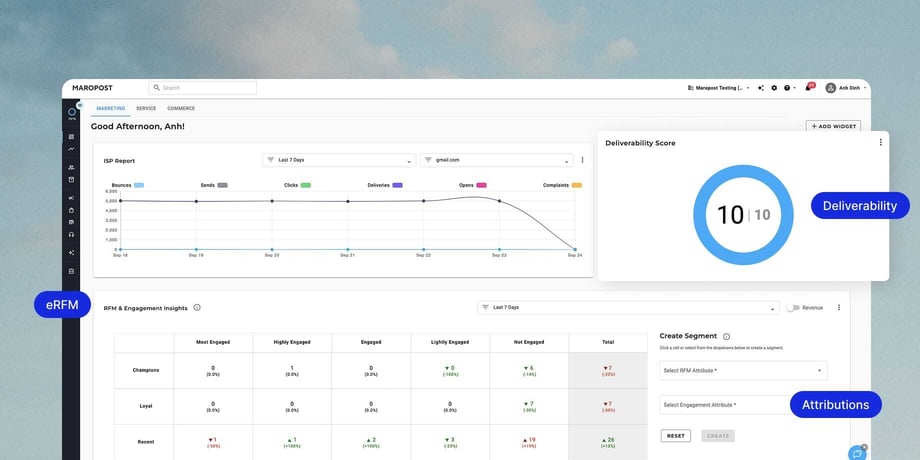
Maropost Maropost Marketing Cloud automates from the contact record, with customer behaviour and purchase activity available to drive campaigns. Automations can trigger from purchase history, and each contact can carry an eRFM score (Essentials and up). Optimize on Open can swap an image when the email is opened. Email is included in the subscription, with SMS and push notifications (through the mobile SDK) supported alongside it.
Structural differences to keep in mind:
- Plan shape: Marketing Cloud publishes Build, Essentials, Professional, and Enterprise. The allowances are contacts and email sends. ActiveCampaign publishes Starter, Plus, Pro, and Enterprise. Monthly sends are capped at 10 times the contact count on Starter and Plus, 12 times on Pro, and 15 times on Enterprise. Both offer a 14-day free trial with no credit card.
- Send timing: Marketing Cloud works out the best time to send a promotional email to each contact from their past purchases and when they are most likely to buy, so the offer arrives when it is most likely to convert. ActiveCampaign offers send-time optimization, with predictive sending only on Pro and Enterprise, and it works from each contact’s email opens, not from what they buy.
- Commerce logic: Both platforms offer product catalog content in email. On ActiveCampaign, it starts on Plus. On Marketing Cloud, the built-in Optimize on Open feature can swap an image when the email is opened.
Market context
Why this email marketing platform comparison matters
Three things decide how an email platform holds up as a program grows: what it costs, whether it sends at the right moment to the right customers, and whether the mail reaches the inbox.
Cost. ActiveCampaign’s published price rises with contacts, from $20 to $196 a month at 1,000 contacts to $822 to $1,578 at 50,000, billed yearly, and monthly sends are capped at 10 to 15 times the contact count. Marketing Cloud’s price follows plan allowances instead, and its Essentials plan is $240 a month billed annually for 250,000 contacts and 2 million emails.
Timing and targeting. Marketing Cloud sends each contact a promotional email when their purchase history says they are most likely to buy, and its eRFM score ranks shoppers on recency, frequency, monetary value, and engagement, so the best customers are easy to find and target. ActiveCampaign’s predictive sending works from email opens, and its scoring sits in sales deals and pipeline lead scores.
Inbox placement. Priority Send mails the most engaged contacts first for better inbox delivery. ActiveCampaign documents no equivalent.
For a growing eCommerce or retail program, Marketing Cloud covers all three: a price that follows plan allowances, send timing and scoring built on purchase behavior, and Priority Send. ActiveCampaign is the stronger fit when the same product needs to hold sales deals, pipeline lead scores, and WhatsApp.
Head-to-head email marketing software comparison
Email marketing features and capabilities
Both platforms offer a drag-and-drop builder, product catalog content, and inbox previews. On ActiveCampaign, the last two are limited to Plus and above. Both can pull outside content into an email from a feed. Marketing Cloud content feeds read XML or JSON data at send time, and ActiveCampaign has an RSS block on every plan, plus RSS-triggered campaigns. Marketing Cloud’s built-in Optimize on Open feature can swap an image when the email is opened.
Both offer A/B testing. On ActiveCampaign’s current plan grid, Starter and Plus list email splits only, and automation splits are limited to Pro and Enterprise.
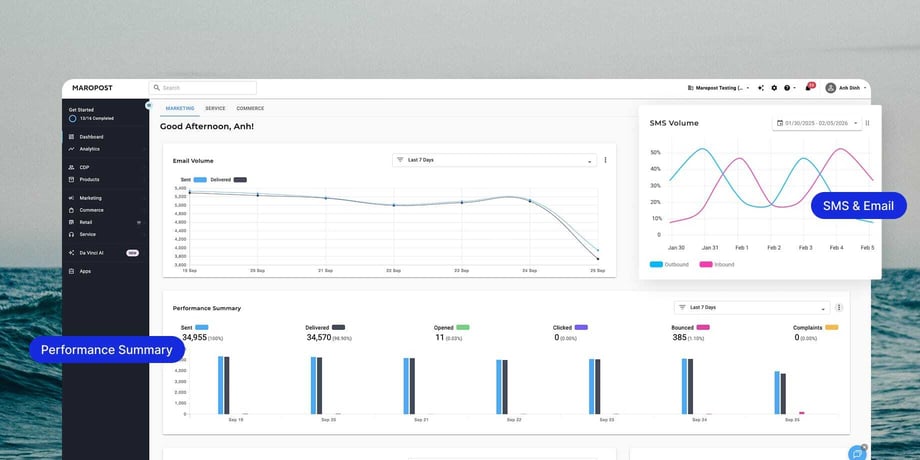
Email deliverability and performance
Both platforms include a spam check, inbox preview testing, custom sending domains, and a dedicated IP option. On ActiveCampaign, inbox preview testing is not included on Starter and is capped at five a month on Plus and Pro. Marketing Cloud adds Priority Send, which mails the most engaged contacts first, for better inbox delivery. Both also remove inactive contacts. Marketing Cloud cleansing rules you set can run daily and remove inactive contacts and high-open bots, and ActiveCampaign’s Engagement Management tool unsubscribes unengaged contacts from a list you choose, started manually, on every plan.
| Feature | Maropost | ActiveCampaign |
|---|---|---|
| Dedicated IP | Paid add-on, with the number of IPs matched to your weekly sending volume | Paid add-on on any plan, and only with at least 100,000 active, opted-in, engaged contacts you email regularly. Pre-warmed or cold-IP warm-up |
| Inbox testing | Render preview across email clients and devices | Inbox preview and testing: not on Starter, five per month on Plus and Pro, unlimited on Enterprise |
| Priority Send | Mails the most engaged contacts first, for better inbox delivery | No equivalent documented |
| Inactive contact cleanup | Cleansing rules you set can run daily and remove inactive contacts | Engagement Management tool unsubscribes unengaged contacts from a list, started manually, on every plan |
Email marketing automation and workflow logic
Both can update a contact and recover a cart from inside an automation. Push on Marketing Cloud is a journey action and requires the mobile SDK, priced on monthly active users. ActiveCampaign lists push through an integration. Both offer Salesforce. ActiveCampaign lists it only on Enterprise.
Email personalization and AI intelligence
Both offer send-time optimization and product catalog content. On ActiveCampaign, both are limited to Plus and above. Marketing Cloud can also time a send from purchase history, and it can score a contact with eRFM (Essentials and up): recency, frequency, monetary value, and engagement. ActiveCampaign offers predictive sending only on Pro and Enterprise, at each contact’s best time, and conditional content on those same tiers. Deal records and pipeline lead scores are an add-on from Plus.
ActiveCampaign’s Active Intelligence is included on every plan, but it is metered and tiered. Access is limited on Starter and Plus, generative content and images start on Plus, and each plan is capped at 500 AI credits a month for advanced actions such as image generation and translated campaigns. When credits run out, core capabilities keep working and advanced ones pause until more are added. Its predictive sending is based on each contact’s email opens. Marketing Cloud’s send timing and scoring draw on buying behavior: conversion-time optimization delays a send until a customer is most likely to buy, and eRFM scores shoppers on how they buy. Maropost’s Da Vinci AI is available in Marketing Cloud and unifies data across the platform to help users understand, optimize, and personalize. In Marketing Cloud, its Build With AI option drafts the emails and builds the journey on the canvas from a chat about your brand, audience, and goals. Both platforms offer an AI automation builder.
| Feature | Maropost | ActiveCampaign |
|---|---|---|
| Purchase-based send timing | Picks each contact’s send time for a promotional email from their past purchases and when they are most likely to buy | Predictive sending, limited to Pro and Enterprise, based on each contact’s email opens |
| Customer value scoring | eRFM scores (Essentials and up) for recency, frequency, monetary value, and engagement | Deal records and pipeline lead scoring, an add-on from Plus |
Email marketing reporting and revenue attribution
Both platforms report on campaign performance and can attribute revenue from a connected store. On ActiveCampaign, revenue attribution is limited to Pro and above. Marketing Cloud also charts eRFM (Essentials and up) for recency, frequency, monetary value, and engagement. ActiveCampaign includes custom reporting only on Enterprise and lists it as an add-on on Plus and Pro.
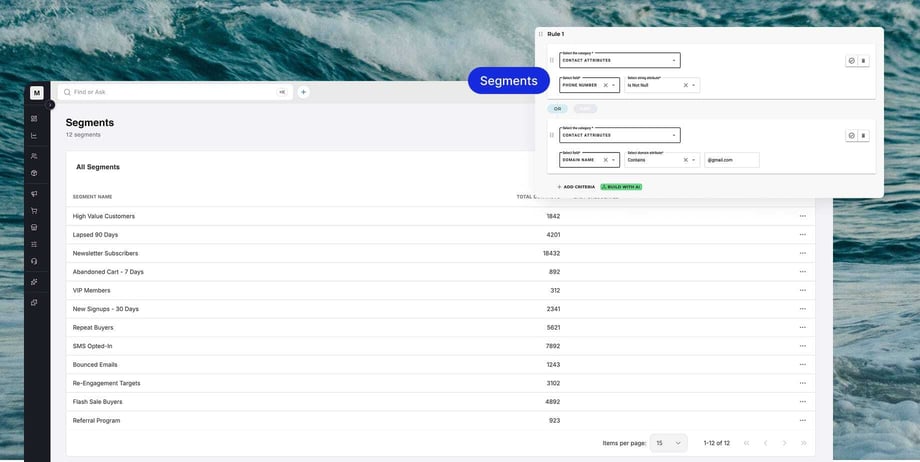
Plans & tiers
Plans, features, and tiers
Maropost plans
Marketing Cloud publishes Build, Essentials, Professional, and Enterprise. A 14-day free trial is available, with no credit card required. Email is in the subscription, and SMS is an add-on on every plan. Plans are sized by contacts and email sends. Prices are in USD.
| Build | Essentials | Professional | Enterprise | |
|---|---|---|---|---|
| Price, billed annually | $29 a month | $240 a month | $720 a month | $1,440 a month |
| Price, billed monthly | $29 a month | $299 a month | $899 a month | $1,799 a month |
| Contacts | 50,000 | 250,000 | 1 million | 5 million |
| Emails | 300,000 | 2 million | 10 million | 50 million |
| Lists | 5 | Unlimited | Unlimited | Unlimited |
| Segments | Unlimited | Unlimited | Unlimited | Unlimited |
| Concurrent journeys | 5 | 10 | 15 | Unlimited |
| Forms | 2 | 3 | Unlimited | Unlimited |
| Landing pages | 1 | 3 | Unlimited | Unlimited |
| eRFM reporting | Not included | Included | Included | Included |
| Brand management | Not included | Not included | Included | Included |
| Relational tables and SQL queries | Not included | Not included | Not included | Included |
| Support | 24/7 helpdesk by phone, live chat, and online request | Same | Same, plus training and a customer success manager | Same, plus training and a customer success manager |
Annual billing is 20% off Essentials, Professional, and Enterprise. Build stays at list price. See Marketing Cloud plans · Talk to sales
ActiveCampaign plans
ActiveCampaign publishes Starter, Plus, Pro, and Enterprise for email and automations, with a 14-day free trial (no credit card). The price scales with contact-list size.
Monthly price by contact count (USD, billed yearly, as of October 19, 2026)
| Contacts | Starter | Plus | Pro | Enterprise |
|---|---|---|---|---|
| 1,000 | $20 | $66 | $107 | $196 |
| 10,000 | $201 | $255 | $506 | $795 |
| 25,000 | $528 | $525 | $849 | $1,187 |
| 50,000 | Not listed | $822 | $1,308 | $1,578 |
Features by tier
| Starter | Plus | Pro | Enterprise | |
|---|---|---|---|---|
| User seats | 1 | 1 | 3 | 5 |
| Monthly email sends | 10× contacts | 10× contacts | 12× contacts | 15× contacts |
| Actions per automation | 5 | Unlimited | Unlimited | Unlimited |
| A/B tests | Email only | Email only | Email and automations | Email and automations |
| Predictive sending and conditional content | Not included | Not included | Included | Included |
| Revenue attribution | Not included | Not included | Included | Included |
| Inbox preview | Not included | 5 a month | 5 a month | Unlimited |
| Salesforce | Not included | Not included | Not included | Included |
| Premium segmentation, SSO, and HIPAA support | Not included | Not included | Not included | Included |
| Dedicated account team | Not included | Not included | Not included | Included |
| Add-ons | Transactional email | SMS, WhatsApp, pipelines and lead scoring, transactional email, custom reporting | SMS, WhatsApp, pipelines and lead scoring, transactional email, custom reporting | SMS, WhatsApp, pipelines and lead scoring, transactional email. Custom reporting included |
Above 50,000 contacts, ActiveCampaign pricing is custom. At 25,000 contacts its published plans run from $525 to $1,187 a month billed yearly, and at 50,000 contacts from $822 to $1,578. Marketing Cloud tiers follow included contacts and email sends instead: Essentials is $240 a month billed annually with 250,000 contacts and 2 million emails, and Build includes 50,000 contacts and 300,000 emails at $29 a month. The plans differ in features and send allowances, so compare them against what your program needs. See ActiveCampaign plans
Customer reviews
G2 rates both products 4.4 out of 5. Reviewers highlight different strengths.
| Maropost | ActiveCampaign | |
|---|---|---|
| G2 rating | 4.4/5 | 4.4/5 |
| What reviewers highlight | Inbox placement, eCommerce segmentation, and email and SMS on one platform | Ease of use and the automation and email builders |






Implementation and onboarding
Maropost onboarding
Guided migration is available, and the helpdesk is open 24/7 by phone, live chat, and online request on every plan. Professional and Enterprise add training and a customer success manager, and higher plans add a dedicated deliverability manager.
The path is short: export your audiences, templates, and suppression data, import them by CSV, then authenticate your sending domains and rebuild the priority automations, such as welcome and abandoned cart.
ActiveCampaign onboarding
Onboarding is included on paid plans, basic on Starter and Plus and priority on Pro and Enterprise, as a live 1:1 session or an AI course depending on the plan. Migration help is limited to the first 10 objects (for example contact lists, forms, and templates) on qualifying plans. Action steps without a matching function, reporting data, lead scoring, media libraries, and custom fonts are among the documented exclusions.
Live chat runs only on published hours (Monday–Friday, 3:00 a.m.–11:00 p.m. CT, and Sunday, 6:00 p.m.–11:00 p.m. CT), with a support ticket created outside them. A dedicated account team is only on Enterprise.
Final verdict
Which should you choose?
Choose Maropost if:
- You want send times based on purchase history, and an eRFM score on the contact (Essentials and up)
- You want Priority Send, with the most engaged contacts mailed before the rest of the list
- You want price set by plan allowance, not list size: Essentials is $240 a month billed annually for 250,000 contacts and 2 million emails, where ActiveCampaign’s published price at 25,000 contacts is $525 to $1,187 a month billed yearly
- You want email in the subscription, with SMS running from the same contact record
- You want 24/7 chat on every plan, with a customer success manager on Professional and Enterprise and a deliverability manager on higher plans
Best for: Growing and scaling eCommerce brands and high-volume senders that want purchase-based send timing and Priority Send, with email and SMS on shared customer data.
Choose ActiveCampaign if:
- You want sales deals and pipeline lead scores in the same product as the campaign (an add-on from Plus)
- You want WhatsApp in the same program as email (an add-on from Plus)
- You want a published app directory of 1,000-plus connections, with Salesforce only on Enterprise
Best for: Small and mid-sized businesses that want sales deals, pipeline lead scores, or WhatsApp alongside email.
The bottom line
ActiveCampaign is a strong way to run email and automations from a contact record, and to keep sales deals and pipeline lead scores in that same product. Those sales tools and WhatsApp are add-ons from Plus.
Marketing Cloud is the stronger choice when purchase-based send timing, Priority Send, and an eRFM score (Essentials and up) decide the program, and the more reasonable choice for a brand whose list and send volume are growing.
If a send cap tied to list size is already the constraint, this comparison is the one to make before the next contract.